
360 Camera
Insta360 X6 vs X5 vs X4 Air vs X4: Should You Upgrade in 2026?
Should you upgrade to the Insta360 X6? Compare X6 vs X5, X4 Air and X4 across image quality, 8K video, low light, battery, lenses, waterproofing and more.
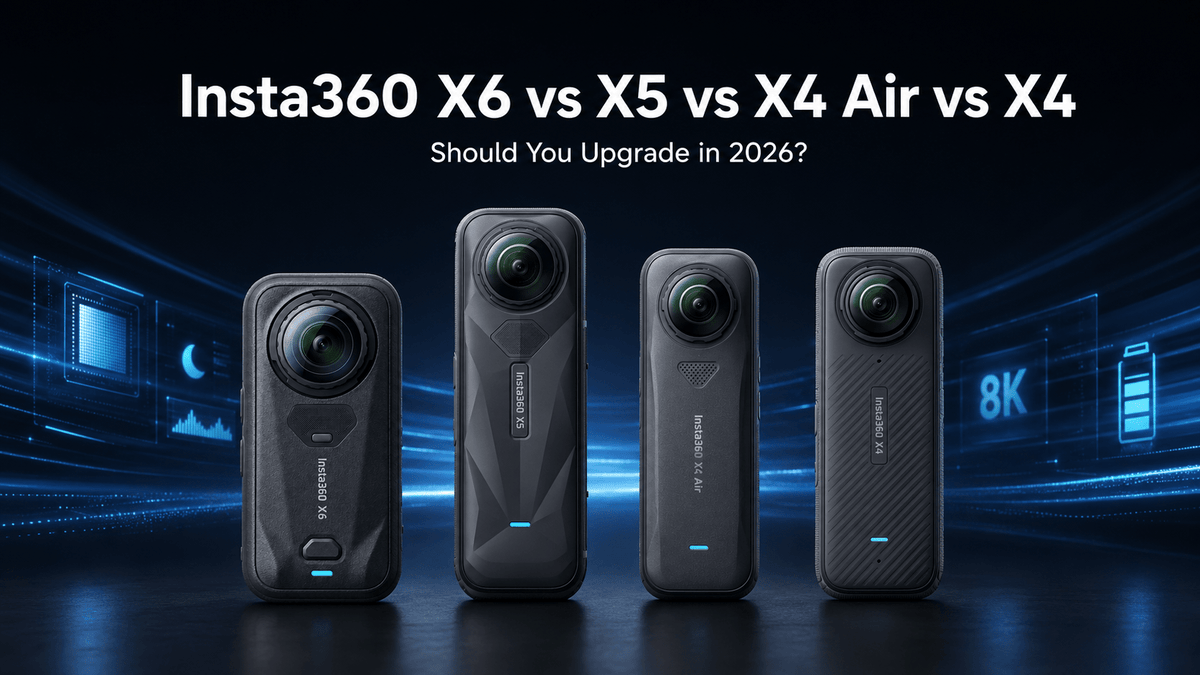
Insta360 X6 vs X5 vs X4 Air vs X4: Should You Upgrade in 2026?
If you already own an Insta360 X4 Air, X4 or X5, is the new Insta360 X6 really worth upgrading to?
The short answer is: X4 owners will see the biggest overall leap, X4 Air owners gain substantially better imaging and professional video capability, while X5 owners get a more selective but still meaningful flagship upgrade.
The X6 introduces dual custom Sony 1/1.1-inch square sensors that provide an imaging area equivalent to 1-inch sensors when shooting 360 content, 8K video at up to 50fps, 120MP 360 photos, 10-bit I-Log, native Dolby Vision, up to 5K60fps flat video, 47GB of usable built-in storage, improved replaceable lenses and 140 minutes of 8K30fps recording.
For buyers who want the newest flagship, the Insta360 X6 8K 360 Camera is now the model to compare against the previous Insta360 X5, Insta360 X4, and lightweight X4 Air.
Highlights
-
X6 increases maximum 360 recording from 8K30fps to 8K50fps.
-
New dual 1/1.1-inch custom Sony sensors are larger than the X5's dual 1/1.28-inch sensors.
-
X6 records 120MP 360 photos, compared with 72MP on X5 and X4.
-
10-bit I-Log and Dolby Vision give X6 a much stronger professional colour workflow.
-
Flat video increases to 5K60fps or 4K120fps, allowing X6 to work more effectively as a conventional action camera.
-
Battery life reaches 140 minutes at 8K30fps, versus 93 minutes on X5, 88 minutes on X4 Air and 75 minutes on X4.
-
Waterproofing improves to 20m without a housing.
-
X6 adds 64GB built-in storage with approximately 47GB usable.
-
Replaceable Lenses 2.0 are designed to be substantially more scratch-resistant than X5's first-generation replaceable lenses.
Insta360 X6 vs X5 vs X4 Air vs X4 Comparison Matrix
| Feature | Insta360 X6 | Insta360 X5 | Insta360 X4 Air | Insta360 X4 |
|---|---|---|---|---|
| Imaging sensors | Dual custom Sony 1/1.1" square sensors, 1-inch imaging equivalent | Dual 1/1.28" | Dual 1/1.8" | 1/2" |
| Processing | 4nm AI chip + 2 Pro Imaging Chips | 5nm AI chip + 2 Pro Imaging Chips | 5nm AI chip | 5nm AI chip |
| Max 360 video | 8K50fps | 8K30fps | 8K30fps | 8K30fps |
| Other high-frame-rate 360 video | 6K60fps / 4K100fps | 5.7K60fps | 6K50fps | 5.7K60fps |
| Low-light PureVideo | Yes, upgraded imaging system | Yes | No | No |
| Flat / single-lens video | 5K60fps / 4K120fps | 4K60fps | 4K60fps | 4K60fps |
| Ultra-wide flat video | 5K30fps, up to 170° FOV | Up to 4K | 4K | 4K |
| Max 360 photo | 120MP | 72MP | 29MP | 72MP |
| Professional colour | 10-bit I-Log + Dolby Vision | I-Log | Standard / Vivid / Flat | Standard / Vivid / Flat |
| Replaceable camera lenses | Replaceable Lenses 2.0 | Yes | Yes | No, removable lens guards |
| Built-in storage | 64GB, approx. 47GB usable | No | No | No |
| Battery | 2600mAh | 2400mAh | 2010mAh | 2290mAh |
| 8K30fps runtime | 140 mins | 93 mins | 88 mins | 75 mins |
| Waterproof without case | 20m | 15m | 15m | 10m |
| Weight | 196g | 200g | 165g | 203g |
| Stabilisation | FlowState + 360 Horizon Lock | FlowState + 360 Horizon Lock | FlowState + 360 Horizon Lock | FlowState + 360 Horizon Lock |
| Best reason to choose | Best overall image quality and capability | Strong flagship value | Lightest and most portable | Lower-cost older 8K option |
The specifications above are based on Insta360's current official X4 Air, X4, X5 and X6 specifications. Battery figures are particularly useful because they compare the cameras at the same 8K30fps recording mode rather than mixing different resolutions.
1. The biggest X6 upgrade is the imaging system
Resolution alone does not tell the full story.
The X4 already recorded 8K, while X4 Air and X5 also offer 8K30fps. The important change with X6 is what happens before the video becomes an 8K file.
X4 uses 1/2-inch sensors. X4 Air moves to dual 1/1.8-inch sensors, while X5 made a much larger step to dual 1/1.28-inch sensors. X6 now uses dual custom Sony 1/1.1-inch square sensors. Insta360 states that these deliver an imaging area equivalent to 1-inch sensors when recording 360 content.
Compared with X5, Insta360 says the X6 sensor area is 33% larger. X6 also increases maximum stated dynamic range to 14.5 stops, compared with 13.5 stops quoted for X5.
Why does this matter?
When 360 footage is reframed into a normal 16:9 or vertical video, only part of the original sphere is being used. Better source detail, dynamic range and low-light performance therefore have a direct impact on how clean the final reframed clip looks.
This is one of the strongest reasons to upgrade from X4 or X4 Air, and one of the main reasons an X5 owner may still consider moving to X6.
2. 8K50fps makes X6 much better for action
X4, X4 Air and X5 all top out at 8K30fps.
X6 increases native 360 capture to 8K50fps, while also supporting 6K60fps and 4K100fps in standard 360 video modes.
That additional frame rate matters when filming:
-
cycling
-
motorcycling
-
skiing and snowboarding
-
motorsports
-
running
-
water sports
-
fast travel sequences
-
moving subjects
For static landscapes or casual travel footage, 8K30fps may still be sufficient. But for action footage, the jump to 8K50fps gives X6 significantly more temporal information while retaining full 8K resolution.
3. X6 is a much stronger low-light camera
X5 introduced one of the biggest upgrades over X4 with its larger sensors and PureVideo mode.
X6 builds on that with the larger custom Sony sensors, its new 4nm main processor, two dedicated imaging chips, upgraded PureVideo processing and two ambient-light sensors designed to help with flicker and challenging night scenes.
For anyone regularly shooting:
-
night cycling or motorcycle rides
-
city streets after dark
-
indoor events
-
restaurants and nightlife
-
sunsets
-
concerts
-
dim interiors
-
mixed bright and dark scenes
the image-quality improvement is more meaningful than simply comparing “8K versus 8K”.
Upgrade verdict for low light
X4 → X6: Major upgrade
X4 Air → X6: Major upgrade
X5 → X6: Meaningful upgrade for frequent low-light users
4. 10-bit I-Log and Dolby Vision move X6 closer to professional workflows
X5 introduced I-Log, but X6 expands this to 10-bit I-Log and adds native Dolby Vision recording.
Insta360 specifies more than 1.07 billion colours for X6's 10-bit recording, while its comparison with X5 lists the older camera's I-Log implementation as 8-bit.
That gives creators substantially more room when working with:
-
colour grading
-
mixed lighting
-
skies and highlights
-
shadows
-
professional travel content
-
commercial video
-
YouTube production
-
DaVinci Resolve workflows
For casual users who publish straight to Instagram or TikTok without grading footage, this may not justify upgrading by itself.
For professional creators, it is one of X6's most important changes.
5. X6 can replace more of your conventional action camera work
One of the more practical changes is X6's improved flat-video capability.
X4 Air, X4 and X5 can operate as traditional single-lens action cameras at up to 4K60fps.
X6 moves to 5K60fps flat video, with 5K30fps at up to a 170° field of view and 4K120fps for high-frame-rate action footage.
That means X6 is no longer attractive only because it records everything in 360 degrees.
It can more realistically serve as:
-
an 8K 360 camera,
-
a conventional ultra-wide action camera, and
-
a tracked flat-video camera using InstaFrame 2.0.
InstaFrame 2.0 can output ready-to-share 4K flat footage while retaining an 8K 360 backup in supported modes, giving creators the option to publish quickly while preserving the full scene for later reframing.
6. 120MP photos are a major step up
The X4 and X5 record up to 72MP 360 photos.
X4 Air is optimised more heavily around lightweight video use and records approximately 29MP 360 photos.
X6 increases maximum 360 still resolution to 120MP at 15520 × 7760.
This is particularly useful for:
-
travel photography
-
virtual-tour-style images
-
property documentation
-
landscape capture
-
extracting still frames and alternate views
-
situations where you want to zoom further into a 360 image
If you mainly shoot video, this may be secondary. For hybrid photo/video users, the jump is substantial.
7. Battery life is one of the easiest X6 upgrades to appreciate
At 8K30fps:
-
X4 records for about 75 minutes
-
X4 Air records for about 88 minutes
-
X5 records for about 93 minutes
-
X6 reaches 140 minutes
That gives X6 a very substantial endurance advantage when all four cameras are compared at the same recording resolution and frame rate.
The X6 uses a 2600mAh Xtreme Battery and supports charging to 80% in approximately 24 minutes with a compatible 30W PPS charger.
For long rides, travel days, hiking, motorsports and events, this may be more useful in practice than another headline camera feature.
8. X6 lenses are tougher and still replaceable
X4 relies on removable lens guards rather than user-replaceable camera lenses.
X4 Air and X5 moved to replaceable lenses, which makes accidental damage considerably less painful.
X6 introduces Replaceable Lenses 2.0. Insta360 says the new lenses are five times more scratch-resistant than the X5 generation.
This matters because exposed 360 lenses are naturally more vulnerable than lenses recessed into a conventional camera body.
For cycling, motorcycling, skiing and travel, replaceability is not just a specification. It can determine whether a damaged lens means replacing a lens or losing the camera for repair.
9. Waterproofing improves again
Waterproofing without a housing progresses as follows:
-
X4: 10m
-
X4 Air: 15m
-
X5: 15m
-
X6: 20m
X6 is therefore twice as deep-rated as X4 without an additional housing. Insta360 still recommends the appropriate Invisible Dive Case for properly stitched 360 video underwater because refraction affects 360 stitching.
10. Built-in storage makes X6 harder to get caught without a memory card
X6 includes 64GB of internal storage, with approximately 47GB available for recording, in addition to microSD support.
X5 does not offer built-in storage, and neither do X4 or X4 Air.
It sounds like a small upgrade until you arrive somewhere and realise the microSD card is still sitting in your computer.
For creators, internal storage can also act as useful emergency capacity.
11. X6 reduces editing work with AI Director and PanoMind
360 cameras offer enormous creative flexibility, but reframing can also create more post-production work.
X6 introduces Insta360's PanoMind multimodal AI system together with AI Director. Insta360 says AI Director can analyse footage while the camera charges, identify highlights and deliver an edited clip to the phone, while Auto Edit 2.0 can handle framing, camera movement, cuts, music and transitions from selected footage.
For users who shoot frequently but struggle to find time to edit everything they capture, this may be one of the more practical X6 upgrades.
Should You Upgrade From Insta360 X4 to X6?
Yes, for most serious X4 users.
The change is much bigger than the model number suggests.
Moving from X4 to X6 gives you:
-
much larger imaging sensors
-
better low-light capability
-
PureVideo
-
8K50fps instead of 8K30fps
-
120MP instead of 72MP photos
-
5K60fps flat video
-
10-bit I-Log and Dolby Vision
-
user-replaceable lenses
-
140-minute versus 75-minute 8K30fps runtime
-
20m versus 10m waterproofing
-
built-in storage
X6 even weighs slightly less at 196g versus X4's 203g despite its more capable imaging hardware.
Upgrade score: 9/10
If you use your X4 regularly, X6 is a genuine generational upgrade.
Should You Upgrade From Insta360 X4 Air to X6?
It depends on why you bought X4 Air.
X4 Air's biggest advantage remains its 165g weight. X6 weighs 196g, so users who chose X4 Air specifically for helmet mounting, cycling, hiking or minimum carry weight still have a reason to keep it.
However, X6 delivers a substantially stronger imaging platform with much larger sensors, PureVideo, 8K50fps, 120MP photos, 10-bit I-Log, Dolby Vision and longer 8K recording time.
X4 Air records 8K30fps for about 88 minutes versus 140 minutes on X6.
Upgrade score: 8/10 for image quality
Upgrade score: 5/10 if minimum weight is your priority
X4 Air remains the portability winner. X6 is the clear capability winner.
Should You Upgrade From Insta360 X5 to X6?
This is the hardest decision.
X5 is still an excellent 8K 360 camera. It already offers large 1/1.28-inch sensors, PureVideo, replaceable lenses, InstaFrame 2.0, 4K60fps single-lens capture and good battery life.
You should seriously consider upgrading from X5 if you want:
-
better low-light and difficult-lighting performance
-
8K50fps
-
10-bit I-Log
-
Dolby Vision
-
120MP photos
-
5K60fps flat video
-
4K120fps action capture
-
140-minute 8K runtime
-
47GB usable internal storage
-
20m waterproofing
-
tougher Replaceable Lenses 2.0
-
OLED display
-
faster Wi-Fi 6 and USB 3.1 transfers
-
AI Director and newer X6 editing workflows
X6 is also slightly lighter than X5 at 196g versus 200g despite having larger sensors and a larger battery.
However, if you bought X5 recently, mostly film outdoors in good daylight, are happy with 8K30fps and do not need 10-bit colour or longer 8K recording, X5 remains a very capable camera.
Insta360 itself reaches a similar conclusion in its X6 vs X5 upgrade guide: the X6 raises the performance ceiling, but X5 owners shooting mainly in good light do not suddenly have an obsolete camera.
Upgrade score: 7/10 overall
Upgrade score: 9/10 for professionals, low-light shooters and heavy users
Who Should Definitely Upgrade to Insta360 X6?
X6 makes the most sense for creators who frequently shoot action, low light, travel, motorcycles, bicycles, skiing, water sports or professional content.
It is also the strongest upgrade for users who routinely reframe 360 footage into standard horizontal or vertical videos, because better source image quality gives the editor more usable detail to work with.
Professional users who colour-grade footage will benefit much more from X6's 10-bit I-Log capability than casual users who mainly publish straight from the camera.
Who Can Keep Their Current Camera?
You may not need to upgrade immediately if:
-
you own X5 and mainly shoot in bright daylight
-
8K30fps already meets your needs
-
you rarely shoot long continuous clips
-
you do not colour-grade footage
-
you do not need 120MP photos
-
your X5 lenses and battery performance remain satisfactory
-
you specifically bought X4 Air because 165g portability is more important than maximum image quality
A credible upgrade guide should not pretend every owner must buy the newest model.
X6 is the flagship. X5 and X4 Air still make sense for different users.
Which Insta360 Should You Choose in 2026?
Choose X4 Air if minimum weight and easier everyday carrying are your priorities.
Keep or choose X4 mainly if price is substantially lower and you only need basic 8K360 capture.
Choose X5 if you want excellent 8K image quality, PureVideo and replaceable lenses but do not need the newest flagship capabilities.
Choose Insta360 X6 if you want the strongest overall Insta360 X-series imaging system, better low light, higher 8K frame rates, stronger flat-video capability, professional colour options, longer 8K battery life and the newest workflow features.
You can also browse the current Insta360 camera and accessory range for compatible cameras, mounts and shooting accessories.
FAQ
Is Insta360 X6 much better than X5?
X6 is a meaningful flagship upgrade rather than a complete reinvention of the X5. The biggest improvements are its larger 1/1.1-inch custom Sony sensors, 8K50fps recording, 10-bit I-Log, Dolby Vision, 120MP photos, 5K60fps flat video, longer 8K battery life, internal storage and improved lenses.
Is X6 worth upgrading from X4?
For most regular X4 users, yes. The jump in sensor size, low-light capability, lens repairability, 8K frame rate, flat video, battery endurance and waterproofing makes X6 a much larger upgrade from X4 than from X5.
Is X6 worth upgrading from X4 Air?
Yes if image quality and shooting flexibility matter more than minimum weight. X4 Air is still significantly lighter at 165g compared with X6's 196g.
Does Insta360 X6 record 8K at 60fps?
No. Its maximum standard 360 recording rate at 8K is 50fps. It supports 6K up to 60fps and 4K up to 100fps in standard 360 video.
Does Insta360 X6 have internal storage?
Yes. It has 64GB of built-in storage, with approximately 47GB available to the user, plus microSD expansion.
Can I use X5 or X4 Air mounts with X6?
Insta360 states that X6's magnetic mounting system is compatible with X5, X4 Air and Ace Series magnetic mounts across more than 50 mount types. Compatibility should still be checked for each specific accessory.
Where can I buy Insta360 X6?
The Insta360 X6 8K 360 Camera is available from ACE Peripherals together with Insta360 cameras and compatible accessories.
Summary: Is Insta360 X6 Worth the Upgrade?
The Insta360 X6 is the biggest upgrade for existing X4 owners, a major image-quality upgrade for X4 Air users, and a more targeted flagship upgrade for X5 owners.
If you own an X4, the move to X6 is easy to justify.
If you own an X4 Air, upgrade when image quality, low light, battery life and professional features matter more than keeping the camera as light as possible.
If you own an X5, the decision comes down to how demanding your shooting is. X5 remains excellent, but X6 clearly moves ahead for low light, fast action, professional colour, long 8K recording and all-in-one 360 plus flat-video use.
For creators who want the highest-performance X-series camera currently available, the Insta360 X6 is the new flagship choice.


