



QNAP TS-h3087XU-RP 30-Bay Xeon Rackmount NAS
A balanced storage platform for a growing data estate QNAP TS-h3087XU-RP combines Intel Xeon processing, ECC memory and separate SATA drive groups in a rack platform for business data. It can bring capacity storage and SSD performance into one managed system, with built-in 10GbE and QuTS hero ZFS data services. Design the pools around shared files, virtualisation or backup requirements, then choose a supported network and expansion path. Redundant power and serviceable components support the installation, while independent backups remain part of the recovery plan. Highlights Two storage roles Capacity HDD or SATA SSD front bays with separate SATA SSD bays. ZFS storage services and configurable RAID groups. Server-grade foundation Intel Xeon processor and ECC DDR4 memory. Redundant power supplies and hot-swappable drive trays. Connected and expandable Dual 10GBASE-T and dual 2.5GbE networking. Compatible PCIe, SATA, SAS or USB expansion routes. Key Features Give hard drives and flash distinct jobs The appliance combines 24 front bays for compatible SATA HDDs or SATA SSDs with six separate 2.5-inch SATA SSD bays. This lets a storage design separate capacity data, active applications and appropriate flash roles without pretending that all bays accept every drive type. Choose pool layout, SSD endurance and spare capacity around the workload. SAS drives do not become compatible simply because an optional external SAS enclosure is supported. Xeon processing and memory for managed workloads Intel Xeon processing and ECC DDR4 memory support business file services, backup jobs and suitable virtualised applications. Memory expansion should use matching supported modules in the manufacturer installation order. Reserve CPU and RAM for storage tasks before adding virtual machines, containers or surveillance. A higher memory limit is an upgrade option, not a promise that every workload will achieve its best performance at the factory configuration. Build ZFS resilience with valid RAID groups QuTS hero adds checksums, supported self-healing, compression and snapshots to an intentional drive layout. New parity RAID groups are limited to sixteen drives, so larger installations need suitable multiple groups or a valid RAID 50/60 design. Keep SSD-only bays and front capacity bays in their appropriate roles. A resilient RAID layout still needs protected independent backup copies and tested restore procedures. Connect the system without an immediate network-card purchase Dual 10GBASE-T ports and dual 2.5GbE ports are built in, giving the appliance practical network flexibility. Faster networking can be added through compatible PCIe adapters when the complete client, switch and storage path justifies it. Aggregation and multipath require supported host and network configuration, and should be tested with the actual mix of file, block and backup traffic. Leave room for the right expansion route Supported PCIe, SAS, SATA and USB enclosures offer different capacity paths with different host cards and cabling. The current hardware has three PCIe slots, so slot bandwidth, physical clearance and any installed adapters need to be considered together. PCIe expansion enclosures also require a supported BIOS and software combination. Avoid selecting an expansion unit solely because its external connector looks familiar. Plan the rack as part of the purchase The verified appliance rail kit isRAIL-A02-90, purchased separately. Check rack depth, load, airflow and rear cable clearance before installation. Redundant power supplies should be connected to an appropriate power design; they do not protect against every shared circuit or upstream outage. Keep access available for servicing the rear SSD group and other replaceable components. Make recovery part of the storage design Snapshots can provide earlier states of supported data, while Hybrid Backup Sync coordinates copies to suitable remote or cloud destinations. QuTS hero SnapSync can replicate with a compatible target for a deliberately designed recovery process. Decide how frequently data can change, how much interruption the application can tolerate and how recovery will be tested. RAID, snapshots and replication on their own are not a substitute for a protected independent backup. Summary TS-h3087XU-RP is suited to organisations wanting managed capacity storage and purposeful flash use in one rack appliance. Match the RAID groups, drives, memory and networking to the business workload, then add external capacity through a verified expansion route. Monitoring, independent backups and tested recovery turn those features into a practical storage service. What is the difference between the front and SSD bays?ExpandCollapse The 24 front bays accept compatible SATA hard drives or SATA SSDs. The six separate 2.5-inch bays accept compatible SATA SSDs. Neither group is a direct SAS or U.2 NVMe backplane; M.2requires an optional compatible QM2 adapter. Is 10GbE included?ExpandCollapse Yes. Two 10GBASE-T ports and two 2.5GbE ports are built in. Match the switch, cabling and client connection to the required workload. A faster optional card requires compatible PCIe space and a suitable network. Which rail kit should I choose?ExpandCollapse RAIL-A02-90 is the verified appliance rail kit and is purchased separately. Check rack mounting depth, load and service clearance. Expansion enclosures can require different rails. How many cameras can it record?ExpandCollapse QVR Pro on supported QTS has an application ceiling of up to 128 channels with suitable licences; this is not a tested recording maximum for this NAS or drive layout. A validated recording design is required for the actual multi-group array. QVR Pro on supported QTS includes 8 channels. QVR Surveillance provides 2 base channels plus 6 after eligible registration, giving 8 total. Extra channels require the appropriate software and licences; QuTS hero extra-channel expansion must be verified before deployment. Can I create one large parity RAID group?ExpandCollapse New RAID 5, RAID 6 and triple-parity groups are limited to sixteen drives, including the parity groups within RAID 50/60. Use a supported multiple-group design for a larger array and confirm the pool layout before loading production data. Do redundant power supplies replace a UPS or backup?ExpandCollapse No. Redundant supplies support selected power-module faults when wired appropriately. A UPS, a suitable electrical design and independent tested backups address different risks. Plan the protection and recovery requirements for the complete application.
Add-ons (4)
Pickup available at 3005, Ubi Avenue 3, #01-88
Usually ready in 2-4 Business Day (Excluding Public Holiday)
QNAP TS-h3087XU-RP 30-Bay Xeon Rackmount NAS
Description
A balanced storage platform for a growing data estate
QNAP TS-h3087XU-RP combines Intel Xeon processing, ECC memory and separate SATA drive groups in a rack platform for business data. It can bring capacity storage and SSD performance into one managed system, with built-in 10GbE and QuTS hero ZFS data services. Design the pools around shared files, virtualisation or backup requirements, then choose a supported network and expansion path. Redundant power and serviceable components support the installation, while independent backups remain part of the recovery plan.
Highlights
Two storage roles
- Capacity HDD or SATA SSD front bays with separate SATA SSD bays.
- ZFS storage services and configurable RAID groups.
Server-grade foundation
- Intel Xeon processor and ECC DDR4 memory.
- Redundant power supplies and hot-swappable drive trays.
Connected and expandable
- Dual 10GBASE-T and dual 2.5GbE networking.
- Compatible PCIe, SATA, SAS or USB expansion routes.
Key Features
Give hard drives and flash distinct jobs
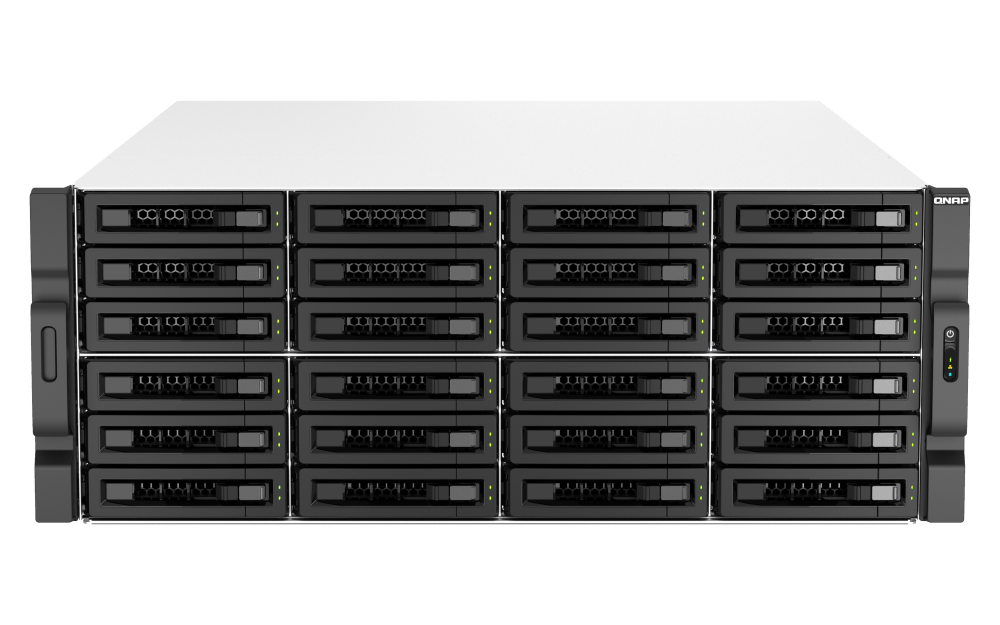
The appliance combines 24 front bays for compatible SATA HDDs or SATA SSDs with six separate 2.5-inch SATA SSD bays. This lets a storage design separate capacity data, active applications and appropriate flash roles without pretending that all bays accept every drive type. Choose pool layout, SSD endurance and spare capacity around the workload. SAS drives do not become compatible simply because an optional external SAS enclosure is supported.
Xeon processing and memory for managed workloads
Intel Xeon processing and ECC DDR4 memory support business file services, backup jobs and suitable virtualised applications. Memory expansion should use matching supported modules in the manufacturer installation order. Reserve CPU and RAM for storage tasks before adding virtual machines, containers or surveillance. A higher memory limit is an upgrade option, not a promise that every workload will achieve its best performance at the factory configuration.
Build ZFS resilience with valid RAID groups
QuTS hero adds checksums, supported self-healing, compression and snapshots to an intentional drive layout. New parity RAID groups are limited to sixteen drives, so larger installations need suitable multiple groups or a valid RAID 50/60 design. Keep SSD-only bays and front capacity bays in their appropriate roles. A resilient RAID layout still needs protected independent backup copies and tested restore procedures.
Connect the system without an immediate network-card purchase
Dual 10GBASE-T ports and dual 2.5GbE ports are built in, giving the appliance practical network flexibility. Faster networking can be added through compatible PCIe adapters when the complete client, switch and storage path justifies it. Aggregation and multipath require supported host and network configuration, and should be tested with the actual mix of file, block and backup traffic.
Leave room for the right expansion route
Supported PCIe, SAS, SATA and USB enclosures offer different capacity paths with different host cards and cabling. The current hardware has three PCIe slots, so slot bandwidth, physical clearance and any installed adapters need to be considered together. PCIe expansion enclosures also require a supported BIOS and software combination. Avoid selecting an expansion unit solely because its external connector looks familiar.
Plan the rack as part of the purchase
The verified appliance rail kit isRAIL-A02-90, purchased separately. Check rack depth, load, airflow and rear cable clearance before installation. Redundant power supplies should be connected to an appropriate power design; they do not protect against every shared circuit or upstream outage. Keep access available for servicing the rear SSD group and other replaceable components.
Make recovery part of the storage design
Snapshots can provide earlier states of supported data, while Hybrid Backup Sync coordinates copies to suitable remote or cloud destinations. QuTS hero SnapSync can replicate with a compatible target for a deliberately designed recovery process. Decide how frequently data can change, how much interruption the application can tolerate and how recovery will be tested. RAID, snapshots and replication on their own are not a substitute for a protected independent backup.
Summary
TS-h3087XU-RP is suited to organisations wanting managed capacity storage and purposeful flash use in one rack appliance. Match the RAID groups, drives, memory and networking to the business workload, then add external capacity through a verified expansion route. Monitoring, independent backups and tested recovery turn those features into a practical storage service.
What is the difference between the front and SSD bays?
The 24 front bays accept compatible SATA hard drives or SATA SSDs. The six separate 2.5-inch bays accept compatible SATA SSDs. Neither group is a direct SAS or U.2 NVMe backplane; M.2requires an optional compatible QM2 adapter.
Is 10GbE included?
Yes. Two 10GBASE-T ports and two 2.5GbE ports are built in. Match the switch, cabling and client connection to the required workload. A faster optional card requires compatible PCIe space and a suitable network.
Which rail kit should I choose?
RAIL-A02-90 is the verified appliance rail kit and is purchased separately. Check rack mounting depth, load and service clearance. Expansion enclosures can require different rails.
How many cameras can it record?
QVR Pro on supported QTS has an application ceiling of up to 128 channels with suitable licences; this is not a tested recording maximum for this NAS or drive layout. A validated recording design is required for the actual multi-group array. QVR Pro on supported QTS includes 8 channels. QVR Surveillance provides 2 base channels plus 6 after eligible registration, giving 8 total. Extra channels require the appropriate software and licences; QuTS hero extra-channel expansion must be verified before deployment.
Can I create one large parity RAID group?
New RAID 5, RAID 6 and triple-parity groups are limited to sixteen drives, including the parity groups within RAID 50/60. Use a supported multiple-group design for a larger array and confirm the pool layout before loading production data.
Do redundant power supplies replace a UPS or backup?
No. Redundant supplies support selected power-module faults when wired appropriately. A UPS, a suitable electrical design and independent tested backups address different risks. Plan the protection and recovery requirements for the complete application.
Specs
QNAP TS-h3087XU-RP 30-Bay Xeon Rackmount NAS
The QNAP TS-h3087XU-RP is a Xeon-based rackmount NAS combining front SATA HDD or SSD bays with separate 2.5-inch SATA SSD bays. ECC memory, dual 10GbE networking and redundant power provide a practical platform for managed business storage. QuTS hero supplies ZFS data services, with QTS available as an alternative. Plan drive groups, flash endurance, backup copies and PCIe expansion together, and select the verified rail kit for the intended rack installation.
| Specification | Details |
|---|---|
| Hardware and connectivity | |
| Processor | Intel Xeon E-2378; 8 cores/16 threads; 2.6GHz up to 4.8GHz. |
| Factory memory | 64GB ECC DDR4. |
| Memory expansion | 4 DDR4 ECC UDIMM slots; maximum 128GB using 4 × 32GB. Dual-module configurations require matching modules. |
| System flash | 5GB with dual-boot OS protection. |
| Drive bays | 30 total: 24 front 3.5-inch SATA bays for compatible HDDs or2.5-inch SATA SSDs, plus 6 separate 2.5-inch SATA SSD bays. SATA 6Gb/s; hot-swappable. No direct SAS support. |
| NVMe expansion | Optional compatible QM2 PCIe adapter required for M.2 NVMe storage; no built-in M.2 slots. M.2 SSD hot-swap is not supported. |
| Network interfaces | 2 × 10GBASE-T RJ45 plus 2 × 2.5GBASE-T RJ45; faster network adapters are optional. |
| PCIe slots | 3 slots: 1 × PCIe Gen 4 x8 and 2 × PCIe Gen 4 x4. Confirm card dimensions, brackets and remaining clearance. |
| USB | 4 × USB-A 3.2 Gen 2 10Gb/s, 5V/1A. |
| Display and graphics | Optional compatible PCIe graphics adapter required; no standard HDMI output. |
| Storage and software | |
| Operating system | QuTS hero with ZFS supplied; QTS with EXT4 is an alternative. Changing OS requires backup and storage reinitialisation. |
| RAID layouts | Single and RAID 0/1/5/6/10/50/60, with applicable ZFS triple-mirror/triple-parity layouts in QuTS hero; QTS also supports JBOD. Minimum drive counts and OS rules apply. |
| RAID group limit | New RAID 5/6/triple-parity groups and RAID 50/60 subgroups are limited to 16 drives. Larger arrays need an appropriate multi-group layout; existing arrays are not automatically changed. |
| Snapshots and replication | Supported shared-folder/volume and iSCSI LUN snapshots, retention, replication and recovery; QuTS hero SnapSync with a compatible target. |
| Backup and synchronisation | Hybrid Backup Sync for supported NAS, remote, USB and cloud destinations; Qsync for supported clients. Keep a separate tested backup. |
| Accounts and shares | QTS up to 4, 096 local users, 512 groups and 512 shared folders; QuTS hero up to 16, 000 users, 512 groups and 256 shared folders. OS limits and workload constraints apply. |
| File services and access | SMB, NFS and FTP/SFTP services; directory integration, share permissions, encrypted connections and network access controls. |
| iSCSI and virtualisation | Thick/thin block-based LUNs, supported multipath and host integration; QTS also supports file-based LUNs. Virtualization Station and Container Station require compatible guests/images and adequate CPU/RAM. |
| Data reduction | QuTS hero compression and inline deduplication; deduplication requires at least 16GB RAM, with 32GB or more recommended. Performance and effective savings depend on data and workload. |
| Concurrent SMB connections | Up to 11, 000 with maximum memory; actual workload limits apply. |
| Surveillance | |
| Included camera channels | QVR Pro on supported QTS includes 8 channels. QVR Surveillance provides 2 base channels plus 6 after eligible registration, giving 8 total. Extra channels require the appropriate software and licences; QuTS hero extra-channel expansion must be verified before deployment. |
| Recording capacity | QVR Pro on supported QTS has an application ceiling of up to 128 channels with suitable licences; this is not a tested recording maximum for this NAS or drive layout. |
| Capacity conditions | Size recording for the actual drive groups, retention, network and concurrent workloads. The application ceiling is not a recording-performance certification. |
| OS qualification | QTS figures do not establish QuTS hero capacity; confirm extra-channel licensing and application support on the installed OS. |
| Storage expansion | |
| USB enclosures | Up to 2 × TL-D800C or TL-R1200C-RP; up to 2 × TR-002, TR-004 or TR-004U. TR enclosures use separate pools/volumes and do not expand the internal RAID group. |
| SATA enclosures | Up to 2 × TL-D400S, TL-D800S, TL-D1600S, TL-R400S or TL-R1200S-RP. Matching QXP SATA HBA and enclosure-specific SFF-8088/SFF-8644 cables required; select for port count and compatible PCIe slot. |
| SAS enclosures | Up to 16 × TL-R1220Sep-RP or TL-R1620Sep-RP, with a compatible QNAP SAS HBA and external SFF-8644 SAS cables. Enclosure, memory, card-fit and cable requirements apply. Up to 4 × TL-R6020Sep-RP is also supported with the appropriate host adapter and enclosure requirements. |
| PCIe enclosures | Up to 4 × TL-R1200PES-RP, TL-R1600PES-RP or TL-R2400PES-RP. Use QXP-3X4PES in supported slot 2 or 3 with dedicated CAB-PCIE10M-8644-4X cabling, not generic SAS cables. QTS/QuTS hero 5.1.2 or later and the required BIOS revision apply. |
| Required BIOS | Q08HAR16 or later for the listed PCIe PES expansion route. Confirm supported cards, firmware and memory before installation. |
| Planning conditions | Limits apply per supported expansion type and are not additive. USB hardware RAID uses a separate pool or volume. Expansion-unit rails are separate from appliance rails. |
| Physical and electrical | |
| Form factor | 4U rackmount. |
| Dimensions H× W× D | 176.2 × 441.6 × 630.2mm chassis; allow rack ears, cables and service clearance. |
| Weight | Net 23.79kg; gross 29.13kg. |
| Power supply | 2 × 800W redundant supplies; AC100–240V. |
| Typical consumption | 219.03W operating; 149.92W standby under manufacturer test conditions; actual use varies. |
| Cooling | 4 × 80mm system fans. |
| Environment | Operating 0–40°C; storage −20–70°C; 5–95% non-condensing relative humidity, wet-bulb 27°C. |
| Warranty | 5 years. |
| Rail kit | RAIL-A02-90 compatible; purchased separately. |
| Package | NAS, drive trays, 2 power cords, drive-mounting screws, Cat6a Ethernet cable and quick installation guide. Drives, rail kit and optional adapters are not included. |
Add-ons


NASCare Extended Warranty with Loaner Unit for 25-40 Bays


QNAP Rail Kit C01/B01/B02/A02-90/A03-57/E02/E03/S01/S02