


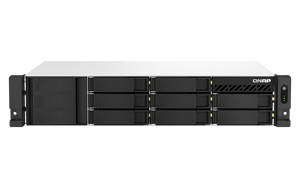
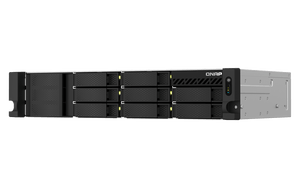
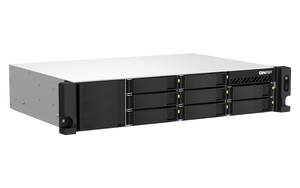
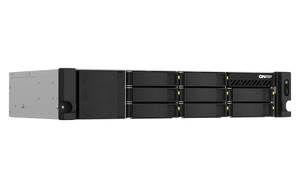
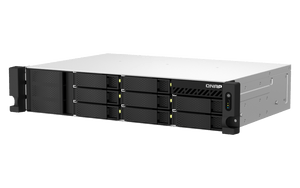
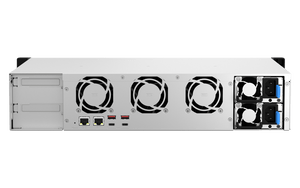

QNAP TS-873AeU 8-Bay Short-Depth Rackmount NAS
Business Storage That Makes More of Your Rack Bring shared files, backups and virtual applications into a compact storage platform built for a working business. The QNAP TS-873AeU combines an AMD Ryzen processor, eight SATA drive bays and dual 2.5GbE networking in a short-depth 2U chassis. Built-in NVMe slots and PCIe expansion give the system room to develop as workloads change. Choose Single or Redundant power supply to match the installation, with the same core storage and processing platform in either configuration. Highlights Compact Rack Integration 297.4 mm chassis depth helps free space for cabling and ventilation in suitable compact racks. Eight SATA bays accommodate compatible hard drives or 2.5-inch SSDs, purchased separately. Ryzen Processing and NVMe Flexibility Four cores and eight threads support concurrent file, backup and application workloads. Two M.2 NVMe slots add SSD caching or an appropriate SSD storage pool without occupying the SATA bays. A Platform That Can Grow Dual 2.5GbE ports support a compatible faster wired network. A PCIe Gen3 ×8 slot accommodates selected network, storage or other expansion cards. Key Features A Shorter Chassis for a Better-Planned Rack A full-depth server is not always the right fit for an office cabinet or AV rack. This 2U enclosure measures 297.4 mm deep, excluding the rack ears and protruding power-supply parts. That leaves more room to plan network cabling and airflow. Confirm the rack depth, mounting posts, rear clearance and optional rail kit before installation. Keep Everyday Work and Demanding Tasks Together The AMD Ryzen Embedded V1500B has four cores and eight threads at 2.2GHz, with AES-NI encryption acceleration. The factory 4GB DDR4 memory supports everyday storage duties and can be upgraded for a larger application workload. Compatible ECC memory is supported; paired modules must match. Allocate sufficient RAM before adding virtual machines, containers or several services to the same NAS. Use NVMe Where It Makes a Difference Two M.2 2280 PCIe Gen3 ×1 slots can host compatible NVMe SSDs for caching or storage. This separates a suitable faster tier from the eight SATA bays and can help with repeated access or application activity. Select SSDs for the workload and use suitable heatsinks. The built-in M.2 slots do not support hot swapping. Build the Network Around Your Workload Two 2.5GbE RJ45 ports provide a practical step up from Gigabit with compatible switches and clients. Link aggregation can spread suitable concurrent connections across both ports; it does not turn one ordinary file transfer into a 5Gbps connection. A compatible PCIe adapter can add higher-speed networking when the wider storage and client system can make use of it. Plan Recovery Alongside Storage QTS brings shared folders, snapshots, synchronisation and backup tools into one management environment. Hybrid Backup Sync can support an independent backup destination, while snapshots provide another recovery point for supported volumes. These measures complement each other. RAID, a redundant power supply and snapshots do not replace an independent backup or protect against every cause of data loss. Choose the Power Configuration at Purchase Single uses one 250W power supply. Redundant is the factory RP configuration with two power supplies, each rated at a minimum of 300W. Select Redundant when a supported dual-supply arrangement is appropriate to the installation. These are distinct factory configurations; the Single chassis is not offered as an upgrade path to RP. Both still need proper power protection and backup planning. Select the Operating System for the Deployment QTS is the appropriate starting point for the factory 4GB configuration. The model also supports ZFS-based QuTS hero, which requires at least 8GB RAM; additional memory is recommended for heavier workloads. Changing between QTS and QuTS hero requires a planned data migration and storage reinitialisation. Check the required applications and licences before selecting the operating system. Summary The TS-873AeU is a flexible eight-bay storage platform for businesses that need Ryzen processing and room for SSD and network expansion without a deep chassis. Select the power arrangement, compatible drives, memory and backup design together to create a system suited to its actual workload. What is the difference between Single and Redundant?ExpandCollapse Single has one 250W power supply. Redundant is the factory RP model with two supplies, each rated at a minimum of 300W. The processor, factory memory, storage bays and network interfaces are the same. Their weights and measured power consumption differ. Select the required factory configuration when ordering; Single is not upgradeable to RP. Are storage drives and rack rails included?ExpandCollapse No storage drives or optional rail kit are included. Choose compatible SATA drives and check the rack mounting-post distance, hole type and clearance before selecting a rail kit. The Compatible Accessories section links the exact RAIL-B02 option and a manufacturer-listed NAS hard-drive model. Does the factory memory support QuTS hero?ExpandCollapse The factory 4GB configuration needs a memory upgrade before using QuTS hero, which requires at least 8GB. QTS and QuTS hero use different file systems, so changing systems requires backup, migration and reinitialisation. Do not switch the operating system on a working NAS without a recovery plan. Does it include 10GbE networking?ExpandCollapse No. The built-in connections are two 2.5GbE RJ45 ports. A compatible PCIe network card can add higher-speed networking. Match the card, switch, cabling and client equipment, and check that the drives and workload can benefit from the added bandwidth. Can the M.2 SSDs be replaced while the NAS is running?ExpandCollapse No. The two built-in M.2 slots do not support hot swapping. Shut the system down and follow the hardware procedure before fitting or replacing M.2 SSDs. The supported SATA drive bays have separate hot-swap capability. Can it record IP cameras as well as store business files?ExpandCollapse Yes, with a supported QVR application and compatible cameras. QVR Pro on QTS includes eight recording channels. QVR Surveillance has two built-in channels with six more claimable by registration. Additional licences and the usable camera workload depend on the application, operating system, memory, camera settings and other NAS activity. See the separate surveillance specifications.
Add-ons (3)
Pickup available at 3005, Ubi Avenue 3, #01-88
Usually ready in 2-4 Business Day (Excluding Public Holiday)
QNAP TS-873AeU 8-Bay Short-Depth Rackmount NAS
Description
Business Storage That Makes More of Your Rack
Bring shared files, backups and virtual applications into a compact storage platform built for a working business. The QNAP TS-873AeU combines an AMD Ryzen processor, eight SATA drive bays and dual 2.5GbE networking in a short-depth 2U chassis. Built-in NVMe slots and PCIe expansion give the system room to develop as workloads change. Choose Single or Redundant power supply to match the installation, with the same core storage and processing platform in either configuration.
Highlights
Compact Rack Integration
- 297.4 mm chassis depth helps free space for cabling and ventilation in suitable compact racks.
- Eight SATA bays accommodate compatible hard drives or 2.5-inch SSDs, purchased separately.
Ryzen Processing and NVMe Flexibility
- Four cores and eight threads support concurrent file, backup and application workloads.
- Two M.2 NVMe slots add SSD caching or an appropriate SSD storage pool without occupying the SATA bays.
A Platform That Can Grow
- Dual 2.5GbE ports support a compatible faster wired network.
- A PCIe Gen3 ×8 slot accommodates selected network, storage or other expansion cards.
Key Features
A Shorter Chassis for a Better-Planned Rack
A full-depth server is not always the right fit for an office cabinet or AV rack. This 2U enclosure measures 297.4 mm deep, excluding the rack ears and protruding power-supply parts. That leaves more room to plan network cabling and airflow. Confirm the rack depth, mounting posts, rear clearance and optional rail kit before installation.
Keep Everyday Work and Demanding Tasks Together
The AMD Ryzen Embedded V1500B has four cores and eight threads at 2.2GHz, with AES-NI encryption acceleration. The factory 4GB DDR4 memory supports everyday storage duties and can be upgraded for a larger application workload. Compatible ECC memory is supported; paired modules must match. Allocate sufficient RAM before adding virtual machines, containers or several services to the same NAS.
Use NVMe Where It Makes a Difference
Two M.2 2280 PCIe Gen3 ×1 slots can host compatible NVMe SSDs for caching or storage. This separates a suitable faster tier from the eight SATA bays and can help with repeated access or application activity. Select SSDs for the workload and use suitable heatsinks. The built-in M.2 slots do not support hot swapping.
Build the Network Around Your Workload
Two 2.5GbE RJ45 ports provide a practical step up from Gigabit with compatible switches and clients. Link aggregation can spread suitable concurrent connections across both ports; it does not turn one ordinary file transfer into a 5Gbps connection. A compatible PCIe adapter can add higher-speed networking when the wider storage and client system can make use of it.
Plan Recovery Alongside Storage
QTS brings shared folders, snapshots, synchronisation and backup tools into one management environment. Hybrid Backup Sync can support an independent backup destination, while snapshots provide another recovery point for supported volumes. These measures complement each other. RAID, a redundant power supply and snapshots do not replace an independent backup or protect against every cause of data loss.
Choose the Power Configuration at Purchase
Single uses one 250W power supply. Redundant is the factory RP configuration with two power supplies, each rated at a minimum of 300W. Select Redundant when a supported dual-supply arrangement is appropriate to the installation. These are distinct factory configurations; the Single chassis is not offered as an upgrade path to RP. Both still need proper power protection and backup planning.
Select the Operating System for the Deployment
QTS is the appropriate starting point for the factory 4GB configuration. The model also supports ZFS-based QuTS hero, which requires at least 8GB RAM; additional memory is recommended for heavier workloads. Changing between QTS and QuTS hero requires a planned data migration and storage reinitialisation. Check the required applications and licences before selecting the operating system.
Summary
The TS-873AeU is a flexible eight-bay storage platform for businesses that need Ryzen processing and room for SSD and network expansion without a deep chassis. Select the power arrangement, compatible drives, memory and backup design together to create a system suited to its actual workload.
What is the difference between Single and Redundant?
Single has one 250W power supply. Redundant is the factory RP model with two supplies, each rated at a minimum of 300W. The processor, factory memory, storage bays and network interfaces are the same. Their weights and measured power consumption differ. Select the required factory configuration when ordering; Single is not upgradeable to RP.
Are storage drives and rack rails included?
No storage drives or optional rail kit are included. Choose compatible SATA drives and check the rack mounting-post distance, hole type and clearance before selecting a rail kit. The Compatible Accessories section links the exact RAIL-B02 option and a manufacturer-listed NAS hard-drive model.
Does the factory memory support QuTS hero?
The factory 4GB configuration needs a memory upgrade before using QuTS hero, which requires at least 8GB. QTS and QuTS hero use different file systems, so changing systems requires backup, migration and reinitialisation. Do not switch the operating system on a working NAS without a recovery plan.
Does it include 10GbE networking?
No. The built-in connections are two 2.5GbE RJ45 ports. A compatible PCIe network card can add higher-speed networking. Match the card, switch, cabling and client equipment, and check that the drives and workload can benefit from the added bandwidth.
Can the M.2 SSDs be replaced while the NAS is running?
No. The two built-in M.2 slots do not support hot swapping. Shut the system down and follow the hardware procedure before fitting or replacing M.2 SSDs. The supported SATA drive bays have separate hot-swap capability.
Can it record IP cameras as well as store business files?
Yes, with a supported QVR application and compatible cameras. QVR Pro on QTS includes eight recording channels. QVR Surveillance has two built-in channels with six more claimable by registration. Additional licences and the usable camera workload depend on the application, operating system, memory, camera settings and other NAS activity. See the separate surveillance specifications.
Specs
QNAP TS-873AeU 8-Bay Short-Depth Rackmount NAS
The QNAP TS-873AeU is an eight-bay, short-depth rackmount NAS with a four-core AMD Ryzen processor, dual 2.5GbE networking and two built-in NVMe slots. Its PCIe slot supports selected expansion cards for a planned upgrade. Single and Redundant factory power configurations share the same core hardware, while their power supplies, weights and measured consumption differ. Drives, optional memory upgrades and rack rails are sold separately.
| Specification | Details |
|---|---|
| Processing and Memory | |
| Processor | AMD Ryzen Embedded V1500B; 4 cores / 8 threads at 2.2GHz; 64-bit x86 |
| Factory Memory and Expansion | 4GB DDR4 SODIMM; 2 slots; maximum 64GB (2 × 32GB) |
| Memory Configuration | Use compatible QNAP memory. ECC memory is supported. Do not mix ECC and non-ECC; dual modules must be identical. |
| Boot Flash | 5GB; dual-boot OS protection |
| Acceleration | AES-NI encryption; optional graphics-card hardware transcoding |
| Storage and Expansion | |
| Drive Bays | 8 × SATA 6Gbps / 3Gbps; supplied without storage drives |
| Compatible Drive Types | 3.5-inch SATA HDDs and 2.5-inch SATA SSDs |
| Drive Servicing | Supported SATA bays are hot-swappable; built-in M.2 slots, where fitted, are not |
| M.2 SSD Slots | 2 × M.2 2280 PCIe Gen3 ×1 NVMe |
| SSD Features | Supported SSD caching; QTS Qtier and over-provisioning subject to configuration. SSDs sold separately. |
| PCIe Expansion | 1 × PCIe Gen3 ×8 |
| Card Size Limits | 210 × 68.9 × 18.76 mm |
| External Expansion | Compatible QNAP expansion units require the appropriate host connection, card and supported configuration; sold separately |
| Networking and Connectivity | |
| Built-in Ethernet | 2 × 2.5GbE RJ45 |
| RJ45 Link Rates | 2.5GbE / 1GbE / 100Mbps / 10Mbps |
| Network Features | Supported link aggregation, failover and jumbo frames; depend on network configuration. Wake-on-LAN on the 2.5GbE ports. |
| Higher-Speed Expansion | Compatible PCIe network adapters are optional; not included |
| USB | 4 × USB 3.2 Gen2 (10Gbps): 2 Type-A and 2 Type-C |
| Display Output | No built-in HDMI; optional compatible PCIe graphics card required |
| SFP+ Accessories | Not applicable to the built-in RJ45 ports |
| Storage Software and Data Protection | |
| Operating System | QTS; QuTS hero available as an alternative after meeting its requirements |
| QuTS hero Requirements | At least 8GB RAM; factory 4GB needs an upgrade. Switching from QTS requires migration and reinitialisation. |
| RAID under QTS | Single; JBOD; RAID 0 / 1 / 5 / 6 / 10 / 50 / 60, subject to sufficient drives |
| QTS File Sharing | SMB/CIFS, NFS, FTP and supported cross-platform file services |
| Storage Services | Storage pools, shared folders and iSCSI; SSD cache and expansion depend on the selected OS and configuration |
| Protection and Backup | Supported volume/LUN snapshots; Hybrid Backup Sync; Qsync; independent backups recommended |
| Security and Permissions | User and group permissions, supported directory integration, encrypted connections and available security applications |
| Application Planning | Supported virtual machines and containers require adequate memory, compatible software and appropriate resource allocation |
| Concurrent CIFS Connections | 2,000 with maximum installed memory; an application resource limit, not a throughput guarantee |
| Surveillance and Licensing | |
| Supported Recording Applications | QVR Pro and QVR Surveillance on supported QTS releases; application availability depends on firmware and resources |
| QuTS hero Recording | QVR Surveillance is listed for QuTS hero; QVR Pro is specified for QTS. Surveillance channel expansion under QuTS hero is under development, so do not plan unconfirmed paid expansion. |
| QVR Pro Included Channels | 8 recording channels; minimum 4GB RAM |
| QVR Surveillance Included Channels | 2 built-in recording channels; register the NAS to claim 6 additional channels |
| Additional Recording Channels | QVR Pro expansion requires compatible licences and sufficient resources. Confirm the chosen application’s current channel-expansion availability before planning more licensed channels. |
| Maximum Camera Channels | Workload- and application-dependent; no single guaranteed hardware maximum is published for this factory configuration. |
| Recording-Only Sizing Reference | Indicative 55 camera streams for either factory 4GB configuration; extrapolated from a memory-tier model rather than an exact-model measurement. Manufacturer selector reference using 1080p H.264 at 30fps / 4.096Mbps per camera, without playback or AI; not a guaranteed maximum or included licence count. |
| Recording and Remote Clients | Supported MJPEG / H.264 / H.265 camera streams; desktop and mobile QVR clients depend on the chosen application |
| Sizing Factors | Resolution, bitrate, frame rate, retention, RAID/drives, viewing, analytics and other NAS services affect the workable installation |
| Power and Cooling | |
| Single Power Supply | 1 × 250W; 100–240VAC |
| Redundant Power Supply | 2 power supplies, each minimum 300W; 100–240VAC |
| Factory Configuration | Single cannot be upgraded to the RP factory configuration; choose the power option at purchase |
| Typical Operating Consumption | Single 52.49 W; Redundant 58.14 W. QNAP tests with the bays populated; actual consumption varies. |
| Disk Standby Consumption | Single 26.76 W; Redundant 32.19 W |
| Cooling | 3 × 60 mm 12VDC fans |
| Physical and Environmental | |
| Installation | 2U short-depth rackmount |
| Dimensions H × W × D | 88.6 × 432 × 297.4 mm |
| Dimension Notes | Allow additional clearance for rack ears, protruding power-supply components, cabling and ventilation |
| Single Weight | 7.97 kg net; 9.47 kg gross |
| Redundant Weight | 9.2 kg net; 10.7 kg gross |
| Operating Temperature | 0–40°C |
| Storage Temperature | −20–70°C |
| Humidity | 5–95% RH non-condensing; wet-bulb temperature up to 27°C |
| Indicators and Controls | Drive, status and network indicators; power and reset buttons; system warning buzzer |
| Package and Warranty | |
| Included | NAS; 1 Ethernet cable; drive-mounting screws (32 for 3.5-inch and 24 for 2.5-inch drives); quick installation guide |
| Power Cords | Single includes 1; Redundant includes 2 |
| Separate Purchases | Storage drives; optional rack rails, expansion cards, SSD cooling and additional software licences |
| Standard Warranty | 3 years |
| Compatible Accessories | |
| Extended Service | NASCare Extended Warranty with Loaner Unit for 5–8 Bays; optional service, subject to model and service eligibility. |
| Rack Rail Kit | QNAP RAIL-B02; optional, sold separately. Select B02 and verify rack mounting-post depth and hole type. |
| NAS Hard Drive | Seagate IronWolf Pro 20TB ST20000NT001; manufacturer-listed drive with EN01 firmware. Select this exact option; the grouped drive family contains other models that require separate checks. |
Add-ons


NASCare Extended Warranty with Loaner Unit for 5-8 Bays


