

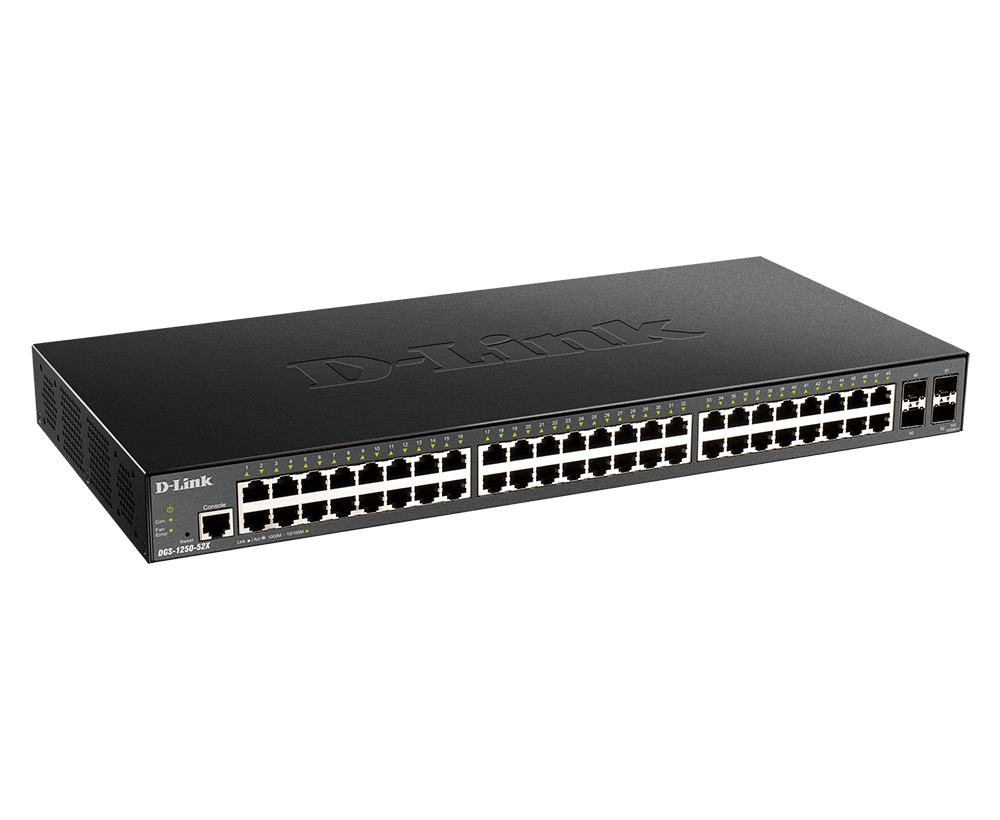


D-Link DGS-1250-52X 48-Port Gigabit Smart Managed Layer 2+ Switch with 10G SFP+
Bring Dense Gigabit Access onto a 10G Uplink Backbone The D-Link DGS-1250-52X pairs 48 Gigabit RJ45 access ports with four dedicated 10G SFP+ uplinks for a larger office floor or rack with dense Gigabit access and shared upstream traffic. It gives everyday wired devices a familiar copper connection while providing a faster upstream path for the combined traffic heading towards storage, servers or the network core. Smart managed Layer 2 features, static IPv4/IPv6 routing and a full command-line interface give administrators control over segmentation, access and maintenance. With 176 Gbps switching capacity, dual software images and configuration files, it is a practical step up when a Gigabit-only uplink has become the constraint in an otherwise suitable access network. Highlights Access and Uplinks 48 × 10/100/1000BASE-T RJ45 access ports. Four dedicated 10G SFP+ uplink ports, separate from the copper ports. 176 Gbps switching capacity and up to 130.95 Mpps forwarding. Managed Network Control Full CLI, dedicated RJ45 console, web GUI and SNMP. VLANs, eight QoS queues, LACP and STP/RSTP/MSTP. Static IPv4/IPv6 routing, 802.1X, ACLs and dual configurations. Key Features Give Shared Upstream Traffic More Room Four dedicated 10G SFP+ ports provide higher-speed links towards compatible storage, servers or an aggregation switch. The 48 RJ45 ports remain Gigabit access connections, so existing desktops and other endpoints can stay in place. This separates the job of connecting local devices from carrying their combined upstream traffic; select compatible optics or direct-attach media for the equipment and distance involved. Build a Clearer Network with VLANs and QoS 802.1Q VLANs let you separate staff, voice, surveillance and other network roles on shared physical infrastructure. Auto Voice VLAN and Auto Surveillance VLAN support suitable deployments, while eight priority queues and multiple scheduling methods help organise competing traffic. Apply consistent VLAN and QoS policies across the uplink and gateway so that the wider network follows the design established at the switch. Add Resilience Without Losing Visibility STP, RSTP and MSTP support redundant topologies, and LACP can aggregate compatible links for multiple traffic flows. IGMP snooping helps control multicast distribution, while LLDP and port mirroring provide useful visibility during installation and troubleshooting. These tools help keep a busy access layer manageable as more devices and applications are added. Apply Access and Routing Policies at the Edge The switch combines 802.1X authentication, ACLs, IP-MAC-port binding and DHCP safeguards with IPv4/IPv6 static routing. Administrators can define which devices connect and how selected local networks communicate. Four IP interfaces, up to 124 IPv4 routes and 50 IPv6 routes suit straightforward routing requirements; dedicated firewall and internet gateway functions remain the responsibility of the appropriate network equipment. Use the Management Interface That Fits the Job A dedicated RJ45 console provides direct command-line access during deployment and troubleshooting, alongside browser management and SNMP for routine administration. The console is a serial management connection, separate from the Ethernet access ports. D-Link Network Assistant assists discovery, and configuration backup, logs and command logging help maintain a clearer record of the running network. Plan Maintenance and Rack Installation Properly Dual software images and dual configuration files give administrators options when preparing changes or recovering a known configuration. The internal universal AC supply and rackmount chassis simplify equipment-room installation, while active fan cooling requires suitable airflow and allowance for operating noise. Use firmware for the supplied hardware revision and match transceivers, power connections and rack hardware before deployment. Summary The DGS-1250-52X suits a larger office floor or rack with dense Gigabit access and shared upstream traffic when Gigabit endpoints need a stronger upstream connection. Dedicated 10G SFP+ ports, comprehensive traffic controls and full CLI management support a more capable access layer, while static routing and security features provide room for a structured network design. Its access ports remain Gigabit, and this non-PoE model does not power connected devices. Frequently Asked Questions Are All the Ports 10 Gigabit?ExpandCollapse No. The 48 RJ45 access ports support 10/100/1000 Mbps. Four separate SFP+ uplink ports support 10G connections using compatible media. The RJ45 access ports do not support 2.5GbE, 5GbE or 10GBASE-T. Are the SFP+ Ports Shared with the Copper Ports?ExpandCollapse No. The four SFP+ uplinks are dedicated ports, giving 52 network ports in total. The additional RJ45 console socket is for serial management and is not another Ethernet data port. Can This Model Supply PoE Power?ExpandCollapse No. The DGS-1250-52X is the non-PoE version. Cameras, access points and phones that require PoE need a compatible injector or a PoE switch, or their own supported power supply. Can It Route Between VLANs?ExpandCollapse Yes. It supports static IPv4/IPv6 routing with up to four IP interfaces, 124 IPv4 static routes and 50 IPv6 static routes. It also supports VLANs, QoS and ACLs. This does not replace a firewall, internet gateway or dynamic-routing platform where those functions are required. How Can I Configure and Monitor It?ExpandCollapse Use the full CLI through the dedicated serial RJ45 console, the web interface or SNMP. D-Link Network Assistant supports discovery, and dual images, configuration backup and logs assist maintenance. Use firmware and management procedures matched to the supplied hardware revision. Is It Suitable for a Quiet Desk Area?ExpandCollapse This model uses active fan cooling rather than a fanless design. Allow for operating noise and keep airflow clear; an equipment rack or suitable communications space is normally more appropriate than a noise-sensitive desk. The internal supply accepts 100–240 V AC, and hardware warranty coverage is five years.
Pickup available at 3005, Ubi Avenue 3, #01-88
Usually ready in 2-4 Business Day (Excluding Public Holiday)
D-Link DGS-1250-52X 48-Port Gigabit Smart Managed Layer 2+ Switch with 10G SFP+
Description
Bring Dense Gigabit Access onto a 10G Uplink Backbone
The D-Link DGS-1250-52X pairs 48 Gigabit RJ45 access ports with four dedicated 10G SFP+ uplinks for a larger office floor or rack with dense Gigabit access and shared upstream traffic. It gives everyday wired devices a familiar copper connection while providing a faster upstream path for the combined traffic heading towards storage, servers or the network core.
Smart managed Layer 2 features, static IPv4/IPv6 routing and a full command-line interface give administrators control over segmentation, access and maintenance. With 176 Gbps switching capacity, dual software images and configuration files, it is a practical step up when a Gigabit-only uplink has become the constraint in an otherwise suitable access network.
Highlights
Access and Uplinks
- 48 × 10/100/1000BASE-T RJ45 access ports.
- Four dedicated 10G SFP+ uplink ports, separate from the copper ports.
- 176 Gbps switching capacity and up to 130.95 Mpps forwarding.
Managed Network Control
- Full CLI, dedicated RJ45 console, web GUI and SNMP.
- VLANs, eight QoS queues, LACP and STP/RSTP/MSTP.
- Static IPv4/IPv6 routing, 802.1X, ACLs and dual configurations.
Key Features
Give Shared Upstream Traffic More Room
Four dedicated 10G SFP+ ports provide higher-speed links towards compatible storage, servers or an aggregation switch. The 48 RJ45 ports remain Gigabit access connections, so existing desktops and other endpoints can stay in place. This separates the job of connecting local devices from carrying their combined upstream traffic; select compatible optics or direct-attach media for the equipment and distance involved.
Build a Clearer Network with VLANs and QoS
802.1Q VLANs let you separate staff, voice, surveillance and other network roles on shared physical infrastructure. Auto Voice VLAN and Auto Surveillance VLAN support suitable deployments, while eight priority queues and multiple scheduling methods help organise competing traffic. Apply consistent VLAN and QoS policies across the uplink and gateway so that the wider network follows the design established at the switch.
Add Resilience Without Losing Visibility
STP, RSTP and MSTP support redundant topologies, and LACP can aggregate compatible links for multiple traffic flows. IGMP snooping helps control multicast distribution, while LLDP and port mirroring provide useful visibility during installation and troubleshooting. These tools help keep a busy access layer manageable as more devices and applications are added.
Apply Access and Routing Policies at the Edge
The switch combines 802.1X authentication, ACLs, IP-MAC-port binding and DHCP safeguards with IPv4/IPv6 static routing. Administrators can define which devices connect and how selected local networks communicate. Four IP interfaces, up to 124 IPv4 routes and 50 IPv6 routes suit straightforward routing requirements; dedicated firewall and internet gateway functions remain the responsibility of the appropriate network equipment.
Use the Management Interface That Fits the Job
A dedicated RJ45 console provides direct command-line access during deployment and troubleshooting, alongside browser management and SNMP for routine administration. The console is a serial management connection, separate from the Ethernet access ports. D-Link Network Assistant assists discovery, and configuration backup, logs and command logging help maintain a clearer record of the running network.
Plan Maintenance and Rack Installation Properly
Dual software images and dual configuration files give administrators options when preparing changes or recovering a known configuration. The internal universal AC supply and rackmount chassis simplify equipment-room installation, while active fan cooling requires suitable airflow and allowance for operating noise. Use firmware for the supplied hardware revision and match transceivers, power connections and rack hardware before deployment.
Summary
The DGS-1250-52X suits a larger office floor or rack with dense Gigabit access and shared upstream traffic when Gigabit endpoints need a stronger upstream connection. Dedicated 10G SFP+ ports, comprehensive traffic controls and full CLI management support a more capable access layer, while static routing and security features provide room for a structured network design. Its access ports remain Gigabit, and this non-PoE model does not power connected devices.
Frequently Asked Questions
Are All the Ports 10 Gigabit?
No. The 48 RJ45 access ports support 10/100/1000 Mbps. Four separate SFP+ uplink ports support 10G connections using compatible media. The RJ45 access ports do not support 2.5GbE, 5GbE or 10GBASE-T.
Are the SFP+ Ports Shared with the Copper Ports?
No. The four SFP+ uplinks are dedicated ports, giving 52 network ports in total. The additional RJ45 console socket is for serial management and is not another Ethernet data port.
Can This Model Supply PoE Power?
No. The DGS-1250-52X is the non-PoE version. Cameras, access points and phones that require PoE need a compatible injector or a PoE switch, or their own supported power supply.
Can It Route Between VLANs?
Yes. It supports static IPv4/IPv6 routing with up to four IP interfaces, 124 IPv4 static routes and 50 IPv6 static routes. It also supports VLANs, QoS and ACLs. This does not replace a firewall, internet gateway or dynamic-routing platform where those functions are required.
How Can I Configure and Monitor It?
Use the full CLI through the dedicated serial RJ45 console, the web interface or SNMP. D-Link Network Assistant supports discovery, and dual images, configuration backup and logs assist maintenance. Use firmware and management procedures matched to the supplied hardware revision.
Is It Suitable for a Quiet Desk Area?
This model uses active fan cooling rather than a fanless design. Allow for operating noise and keep airflow clear; an equipment rack or suitable communications space is normally more appropriate than a noise-sensitive desk. The internal supply accepts 100–240 V AC, and hardware warranty coverage is five years.
Specs
D-Link DGS-1250-52X 48-Port Gigabit Smart Managed Layer 2+ Switch with 10G SFP+
The D-Link DGS-1250-52X is a non-PoE smart managed switch with 48 Gigabit copper access ports and four dedicated 10G SFP+ uplinks. It is designed for a structured business access layer that needs more upstream capacity, traffic separation and direct management access. These specifications cover the access and uplink interfaces separately, along with switching, routing, security and installation requirements. Choose compatible transceivers and use firmware matched to the supplied hardware revision.
| Specification | Details |
|---|---|
| Interfaces and Connectivity | |
| Access Ports | 48 × 10/100/1000BASE-T RJ45; Auto MDI/MDIX; up to 100 m on suitable Category 5e or better cable |
| Uplink Ports | 4 × dedicated 10G SFP+; compatible 1G SFP/10G SFP+ media according to the supported transceiver list |
| Network and Console Ports | 52 independent network ports; separate RJ45 serial console for management |
| Power over Ethernet | No PoE output; external power is required for devices that otherwise rely on PoE |
| Switching Performance | |
| Switching and Forwarding | 176 Gbps switching capacity; up to 130.95 Mpps with 64-byte packets; store-and-forward |
| MAC Table and Packet Buffer | 32K MAC entries; 16 Mbit packet buffer |
| System Memory | 256 MB DDR3; 64 MB flash |
| Jumbo Frames | Up to 12,000 bytes |
| Traffic Management and Resilience | |
| VLANs | IEEE 802.1Q; up to 4,094 static VLAN groups; VLAN IDs 1–4094; asymmetric, Auto Voice and Auto Surveillance VLAN |
| Link Resilience | STP/RSTP/MSTP; LACP up to eight groups and eight ports per group, within available physical ports; loopback detection |
| Multicast | IGMP v1/v2/v3 snooping and querier with 256 groups; MLD v1/v2 awareness with 256 groups |
| Quality of Service | Eight queues per port; 802.1p/DSCP classification; strict priority, WRR or WDRR scheduling; ingress/egress bandwidth control |
| Routing and Security | |
| Static Routing | Four IP interfaces; up to 124 IPv4 and 50 IPv6 static routes; IPv4/IPv6 dual stack |
| Access Control | Up to 50 ACLs and 768 shared IPv4/IPv6/MAC rules; port security up to 64 MAC addresses per port |
| Authentication and Inspection | 802.1X; RADIUS/TACACS+ support; IP-MAC-port binding; ARP inspection/spoofing prevention; DHCP snooping and server screening |
| Traffic Protection | Broadcast/multicast/unicast storm control; D-Link Safeguard Engine; traffic segmentation |
| Management and Maintenance | |
| Management Interfaces | Full CLI; dedicated RJ45 serial console; web GUI; SNMP v1/v2c/v3; D-Link Network Assistant |
| Configuration and Monitoring | Dual software images and configurations; backup/restore; system and command logs; LLDP/LLDP-MED; RMON |
| Diagnostics | Cable diagnostics; port mirroring; loopback detection; digital diagnostic monitoring for compatible optics |
| Power and Cooling | |
| Power Supply | Internal 100–240 V AC, 50/60 Hz |
| Maximum Power Consumption | 51 W at 100 V AC; 51.2 W at 240 V AC |
| Standby Power Consumption | 23 W at 100 V AC; 23.5 W at 240 V AC |
| Cooling and Acoustics | Active fan cooling; Up to 50.7 dBA |
| Heat Dissipation | Up to 174.59 BTU/hr |
| Energy Features | IEEE 802.3az Energy Efficient Ethernet; link-status and cable-length-based power management |
| Physical and Environmental | |
| Dimensions and Device Weight | 440 × 210 × 44 mm (L × W × H); 3.01 kg |
| Temperature | Operating −5 to 50 °C; storage −20 to 70 °C |
| Humidity | Operating and storage 0–95% relative humidity |
| Installation | 19-inch rackmount or desktop installation; keep fan and ventilation paths clear |
| Included Installation Items | Manufacturer-listed power cord, RJ45-to-RS232 console cable, rack brackets/screws and rubber feet; transceivers and data cables sold separately |
| Hardware Warranty | 5 years |