


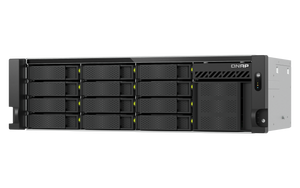


QNAP TS-h1655XeU-RP 16-Bay Short-Depth Rackmount NAS
Make More of Limited Rack Depth A compact communications room should not force a basic storage design. The TS-h1655XeU-RP combines front SATA bays with rear E1.S/M.2 NVMe slots in a short-depth 3U enclosure. An eight-core Intel Atom processor, built-in 10GbE and redundant power provide a flexible foundation for shared files, backup and supported virtualisation workloads. QuTS hero adds ZFS-based storage management, while PCIe and dedicated rear slots leave room for carefully selected upgrades. Highlights Space-Conscious Hybrid Storage Twelve front SATA bays plus four rear E1.S/M.2 PCIe NVMe slots. Short-depth 3U chassis suits installations with restricted rack space. Built-in Business Connectivity One 10GBASE-T port and two 2.5GbE ports are standard. Two PCIe Gen 3 x4 slots support compatible network or expansion adapters. Managed Resilience QuTS hero supports ZFS integrity and recovery tools. Dual redundant PSUs and compatible memory upgrades support deployment planning. Key Features Design a Hybrid Storage Layout Use the twelve SATA bays for compatible hard drives or SATA SSDs and the four rear E1.S/M.2 slots for supported NVMe storage. SSDs can serve supported cache, system or storage-pool roles according to the intended workload. This separates bulk capacity from access patterns that benefit from faster random I/O. Drives are separate, and the appropriate drive format, endurance, adapter and cooling arrangement must be checked before installation. Match the Rear Slots to the Drive Format The rear slots accept supported E1.S SSDs or M.2 2280 SSDs through the specified adapters. Before fitting a 5.9 mm E1.S SSD, remove the built-in E1.S-to-M.2 adapter. Thicker 9.5 mm or 15 mm E1.S drives require the optional compatible tray. Follow the manufacturer installation procedure and cooling recommendations. The same slots can alternatively accept supported E1.S network modules, so one slot cannot provide both storage and a network module at once. Bring 10GbE into a Compact Rack A built-in 10GBASE-T port provides a high-speed copper network connection, with two 2.5GbE ports for further connections or segmentation. Supported optional network modules or PCIe adapters can add capacity where required. Choose compatible switches, client adapters and cabling, and plan the complete traffic path. Aggregate bandwidth and individual transfer speeds depend on configuration, clients and the storage media. Keep Applications Close to Storage The eight-core Intel Atom processor supports shared services and compatible application workloads, with DDR4 memory expandable to 64 GB. Virtualisation, containers and storage-management features need resources allocated for their actual use. The factory configuration uses non-ECC memory; compatible ECC memory is optional and must follow the manufacturer module rules. Assess memory requirements before enabling deduplication or adding multiple application workloads. Plan Recovery and Power Protection QuTS hero provides ZFS checksums, snapshots and supported replication tools to help manage data integrity and recovery. Redundant PSUs reduce the dependency on a single power supply, but should be paired with appropriate protected power feeds and UPS sizing. Keep an independent backup and test restoration. Storage redundancy and local snapshots are useful layers, rather than guarantees against every hardware fault, security incident or accidental deletion. Plan the Rack and Future Expansion The chassis is only 297 mm deep before allowing for cables and installation clearances, making it useful where conventional storage servers are too long. Confirm the rack, compatible optional rails, airflow and service access before deployment. Two PCIe Gen 3 x4 slots can accommodate supported expansion equipment, including suitable networking or QNAP JBOD connectivity. Expansion hardware, enclosures and cabling are separate and model-specific compatibility must be verified. Surveillance with Clear Channel Entitlements Record compatible IP cameras with a supported QVR installation. QVR Pro includes eight recording channels. Current QVR Surveillance provides two standard channels plus six more after QNAP-ID activation, giving eight free channels in that application. Larger systems need the matching channel licences and a storage, network and workload assessment. Choose camera compatibility, bitrate, retention and playback requirements together; free channel counts are not a promise that every camera quality or workload will run at the same capacity. Summary The TS-h1655XeU-RP combines short rack depth with a genuinely flexible SATA and NVMe platform. It suits businesses that need managed shared storage and backup infrastructure while keeping space, networking, power and recovery requirements under control. How Deep Is the Enclosure?ExpandCollapse The manufacturer lists 297 mm chassis depth and a 3U form factor. Allow additional space for cables, rack fittings, airflow and maintenance. Can the Rear Slots Use M.2 SSDs?ExpandCollapse Yes. They support compatible M.2 2280 PCIe NVMe SSDs using the specified E1.S adapters. E1.S drive thickness affects the required tray or adapter arrangement. Are Two 10GbE Ports Built In?ExpandCollapse No. One 10GBASE-T port and two 2.5GbE ports are built in. Additional 10GbE or faster networking requires a supported optional module or card. Is ECC Memory Installed?ExpandCollapse No. The factory configuration has 8 GB non-ECC DDR4. Supported ECC upgrades are optional; use approved matching modules and do not mix ECC with non-ECC memory. Are Drives and Rack Rails Included?ExpandCollapse Drives are separate. The manufacturer package includes the NAS, Ethernet cable, power cords, drive screws and installation guide. A compatible rail kit is optional. How Many Camera Channels Are Included?ExpandCollapse QVR Pro includes eight camera-recording channels. Current QVR Surveillance starts with two standard channels; link the NAS to QNAP ID and activate the additional six to use eight at no channel charge. These are separate application entitlements, not sixteen licences for one recorder. Additional channels require matching licences and workload sizing. QVR Pro Client playback beyond fourteen days requires Gold or Unlimited Playback; that rule does not itself delete older recordings.
附加组件 (2)
可在 3005, Ubi Avenue 3, #01-88 提货
通常在 2 至 4 个工作日内备妥(公共假期除外)
QNAP TS-h1655XeU-RP 16-Bay Short-Depth Rackmount NAS
描述
Make More of Limited Rack Depth
A compact communications room should not force a basic storage design. The TS-h1655XeU-RP combines front SATA bays with rear E1.S/M.2 NVMe slots in a short-depth 3U enclosure. An eight-core Intel Atom processor, built-in 10GbE and redundant power provide a flexible foundation for shared files, backup and supported virtualisation workloads. QuTS hero adds ZFS-based storage management, while PCIe and dedicated rear slots leave room for carefully selected upgrades.
Highlights
Space-Conscious Hybrid Storage
- Twelve front SATA bays plus four rear E1.S/M.2 PCIe NVMe slots.
- Short-depth 3U chassis suits installations with restricted rack space.
Built-in Business Connectivity
- One 10GBASE-T port and two 2.5GbE ports are standard.
- Two PCIe Gen 3 x4 slots support compatible network or expansion adapters.
Managed Resilience
- QuTS hero supports ZFS integrity and recovery tools.
- Dual redundant PSUs and compatible memory upgrades support deployment planning.
Key Features
Design a Hybrid Storage Layout
Use the twelve SATA bays for compatible hard drives or SATA SSDs and the four rear E1.S/M.2 slots for supported NVMe storage. SSDs can serve supported cache, system or storage-pool roles according to the intended workload. This separates bulk capacity from access patterns that benefit from faster random I/O. Drives are separate, and the appropriate drive format, endurance, adapter and cooling arrangement must be checked before installation.
Match the Rear Slots to the Drive Format
The rear slots accept supported E1.S SSDs or M.2 2280 SSDs through the specified adapters. Before fitting a 5.9 mm E1.S SSD, remove the built-in E1.S-to-M.2 adapter. Thicker 9.5 mm or 15 mm E1.S drives require the optional compatible tray. Follow the manufacturer installation procedure and cooling recommendations. The same slots can alternatively accept supported E1.S network modules, so one slot cannot provide both storage and a network module at once.
Bring 10GbE into a Compact Rack
A built-in 10GBASE-T port provides a high-speed copper network connection, with two 2.5GbE ports for further connections or segmentation. Supported optional network modules or PCIe adapters can add capacity where required. Choose compatible switches, client adapters and cabling, and plan the complete traffic path. Aggregate bandwidth and individual transfer speeds depend on configuration, clients and the storage media.
Keep Applications Close to Storage
The eight-core Intel Atom processor supports shared services and compatible application workloads, with DDR4 memory expandable to 64 GB. Virtualisation, containers and storage-management features need resources allocated for their actual use. The factory configuration uses non-ECC memory; compatible ECC memory is optional and must follow the manufacturer module rules. Assess memory requirements before enabling deduplication or adding multiple application workloads.
Plan Recovery and Power Protection
QuTS hero provides ZFS checksums, snapshots and supported replication tools to help manage data integrity and recovery. Redundant PSUs reduce the dependency on a single power supply, but should be paired with appropriate protected power feeds and UPS sizing. Keep an independent backup and test restoration. Storage redundancy and local snapshots are useful layers, rather than guarantees against every hardware fault, security incident or accidental deletion.
Plan the Rack and Future Expansion
The chassis is only 297 mm deep before allowing for cables and installation clearances, making it useful where conventional storage servers are too long. Confirm the rack, compatible optional rails, airflow and service access before deployment. Two PCIe Gen 3 x4 slots can accommodate supported expansion equipment, including suitable networking or QNAP JBOD connectivity. Expansion hardware, enclosures and cabling are separate and model-specific compatibility must be verified.
Surveillance with Clear Channel Entitlements
Record compatible IP cameras with a supported QVR installation. QVR Pro includes eight recording channels. Current QVR Surveillance provides two standard channels plus six more after QNAP-ID activation, giving eight free channels in that application. Larger systems need the matching channel licences and a storage, network and workload assessment. Choose camera compatibility, bitrate, retention and playback requirements together; free channel counts are not a promise that every camera quality or workload will run at the same capacity.
Summary
The TS-h1655XeU-RP combines short rack depth with a genuinely flexible SATA and NVMe platform. It suits businesses that need managed shared storage and backup infrastructure while keeping space, networking, power and recovery requirements under control.
How Deep Is the Enclosure?
The manufacturer lists 297 mm chassis depth and a 3U form factor. Allow additional space for cables, rack fittings, airflow and maintenance.
Can the Rear Slots Use M.2 SSDs?
Yes. They support compatible M.2 2280 PCIe NVMe SSDs using the specified E1.S adapters. E1.S drive thickness affects the required tray or adapter arrangement.
Are Two 10GbE Ports Built In?
No. One 10GBASE-T port and two 2.5GbE ports are built in. Additional 10GbE or faster networking requires a supported optional module or card.
Is ECC Memory Installed?
No. The factory configuration has 8 GB non-ECC DDR4. Supported ECC upgrades are optional; use approved matching modules and do not mix ECC with non-ECC memory.
Are Drives and Rack Rails Included?
Drives are separate. The manufacturer package includes the NAS, Ethernet cable, power cords, drive screws and installation guide. A compatible rail kit is optional.
How Many Camera Channels Are Included?
QVR Pro includes eight camera-recording channels. Current QVR Surveillance starts with two standard channels; link the NAS to QNAP ID and activate the additional six to use eight at no channel charge. These are separate application entitlements, not sixteen licences for one recorder. Additional channels require matching licences and workload sizing. QVR Pro Client playback beyond fourteen days requires Gold or Unlimited Playback; that rule does not itself delete older recordings.
规格
QNAP TS-h1655XeU-RP 16-Bay Short-Depth Rackmount NAS
QNAP TS-h1655XeU-RP combines twelve SATA bays and four E1.S or adapter-based M.2 positions in a short-depth rackmount chassis. Redundant power and built-in networking support shared storage, backup and supported applications. Confirm drive format, required trays, rack rails and network connections before installation. Plan memory, RAID and recording licences for the workload, with an independent backup.
| Specification | Details |
|---|---|
| Processor and Memory | |
| Processor | Intel Atom C5125, 8 cores, 2.8 GHz; 64-bit x86; AES-NI |
| Factory Memory | 8 GB non-ECC DDR4 SODIMM |
| Memory Expansion | 2 × DDR4 SODIMM; up to 64 GB (2 × 32 GB); compatible ECC optional; matching modules required |
| Flash Memory | 4 GB with dual-boot OS protection |
| Storage | |
| SATA Bays | 12 × 3.5-inch SATA 6Gb/s bays; compatible 3.5/2.5-inch SATA HDDs or SATA SSDs |
| Rear SSD Slots | 4 × E1.S/M.2 PCIe Gen 3 x2 slots; M.2 2280 through the specified adapter |
| E1.S Installation | Remove built-in M.2 adapter for 5.9 mm E1.S; optional tray required for 9.5/15 mm E1.S |
| Drive Service | Supported hot-swappable bay/slot arrangement; follow drive-format installation procedure; drives separate |
| Network and Expansion | |
| Built-in Ethernet | 1 × 10GBASE-T and 2 × 2.5GbE RJ45 |
| PCIe | 2 × PCIe Gen 3 x4; each card limit 77 × 20 × 220 mm (H × W × D) |
| USB and Display | 2 × USB 3.2 Gen 1; display output only through a compatible optional graphics card |
| Rear-slot Alternative | Compatible E1.S 10GbE modules can occupy rear slots instead of SSDs |
| Operating System and Data Protection | |
| Operating System | ZFS-based QuTS hero with supported snapshots, backup and replication services |
| File Systems | QTS uses ext4; QuTS hero uses ZFS. Select the supported OS before initialising storage |
| QTS RAID | Single disk, JBOD, RAID 0, 1, 5, 6 and 10, plus RAID 50/60; requires the appropriate number of disks in each group |
| QuTS hero RAID | Single disk, stripe, mirror and supported RAID 5/6/10 layouts; additional parity or nested layouts depend on drive count per RAID group |
| SSD and Block Storage | Supported SSD cache/pools, TRIM, health monitoring and iSCSI targets/LUNs; QTS Qtier and QuTS hero cache designs differ |
| Snapshots | QTS x86 with at least 4GB RAM: up to 1,024 per NAS and 256 per volume/block LUN; QuTS hero platform: up to 65,536, subject to model, resources and free space |
| Replication | Snapshot Replica requires compatible NAS using the same OS; SnapSync is available on supported QuTS hero deployments |
| RAID Management | Supported hot-spare, rebuild, scrubbing and expansion depend on installed drives, OS and RAID layout |
| Surveillance | |
| Maximum Camera Channels | Model-dependent. QNAP does not publish a fixed, guaranteed maximum for this configuration; camera settings and the complete NAS workload determine capacity |
| Application Channel Ceilings | QVR Pro: up to 128; QVR Surveillance: up to 1,024. These are software ceilings, not this NAS’s guaranteed capacity; matching licences are required above the included allowance |
| Included Camera Channels | QVR Pro: 8. QVR Surveillance: 2 standard plus 6 free channels after QNAP ID activation, giving 8. These are separate app entitlements |
| QVR Selector Estimate | QTS: 105 estimated recording channels; QuTS hero needs separate sizing. Reference uses the selected 8GB factory configuration; not a certified maximum |
| Estimate Workload | 1080p H.264, 30fps, 4.096Mbps per camera; recording only, no AI or local playback; manufacturer reference drives/RAID |
| Recording Requirements | Supported OS/app versions and Container Station. QVR Pro requires at least 4GB RAM; QVR Surveillance application minimum is 1GB. The OS and workload may need more |
| Cameras and Video | Check exact camera and firmware compatibility; supported MJPEG/H.264/H.265 streams. Client HEVC decoding or other codec terms may apply |
| QVR Pro Playback | Client playback beyond 14 days requires Gold or Unlimited Playback; this does not set recording retention or automatically delete older files |
| Applications and Security | |
| File Sharing | SMB/CIFS, NFS, FTP/SFTP and supported WebDAV services for Windows, Mac and Linux clients |
| Users and Permissions | Local users/groups, Windows AD/LDAP integration, Windows ACL and supported quotas |
| Maximum CIFS Connections | 2,500 concurrent connections with maximum supported memory; a platform limit, not a performance guarantee |
| Backup and Sync | Hybrid Backup Sync to supported USB/NAS/cloud destinations; Time Machine and Qsync. HDP for PC/VM supports compatible Windows, VMware and Hyper-V workloads with at least 4GB RAM and supported firmware |
| Virtualisation and Containers | Virtualization Station for supported guests with at least 4GB RAM; Container Station for supported Docker and LXC/LXD workloads. Reserve workload resources; guest licences are separate |
| Security and Monitoring | Storage encryption, two-step verification, firewall/access blocking, alerts, logs and SNMP on supported firmware |
| Photos and Media | Supported Qfile Pro, QuMagie and media apps; display, acceleration, codecs and subscriptions depend on hardware and app |
| Power and Environment | |
| Power Supplies | 2 × redundant internal PSUs; minimum 300 W each, 100–240 V AC |
| Power Consumption | 112.42 W disk standby; 121.7 W typical manufacturer fully populated test |
| Cooling | 3 × 80 mm fans; buzzer warning |
| Temperature | Operating 0–40°C; storage −20–70°C |
| Humidity | 5–95% RH, non-condensing; wet-bulb limit 27°C |
| Physical Details | |
| Form Factor | 3U short-depth rackmount |
| Dimensions H × W × D | 133 × 432.4 × 297 mm |
| Net Weight | 10.77 kg |
| Controls and Monitoring | Power/reset buttons; front HDD, rear SSD, system, LAN, USB and power indicators |
| Package and Warranty | |
| Included | NAS, 10GBASE-T cable, 2 power cords, 48 screws for 3.5-inch drives, 36 screws for 2.5-inch drives and Quick Installation Guide |
| Rack Installation | Compatible rail kit optional |
| Warranty | 3 years |
| Compatible Accessories | |
| Rack Rail Kit | QNAP RAIL-B02; optional, sold separately. Verify the rack mounting-post distance and hole type; chassis depth alone does not establish rail fit. |
| Drive Selection | Choose the exact storage-drive model from the manufacturer compatibility list before ordering; drives are sold separately. |
Camera estimates depend on the OS, RAM, drives, RAID, bitrate, playback and AI workload. Apply the selected app’s channel ceiling and licence allowance separately. RAID and local snapshots do not replace an independent backup.
附加组件


