
Buying Guides
HDD, SSD or NVMe NAS: Match Performance to Your Budget
Spend on the storage upgrade your work can use. Compare HDD, SSD and NVMe, distinguish cache from tiering, and turn transfer rates into useful time savings.
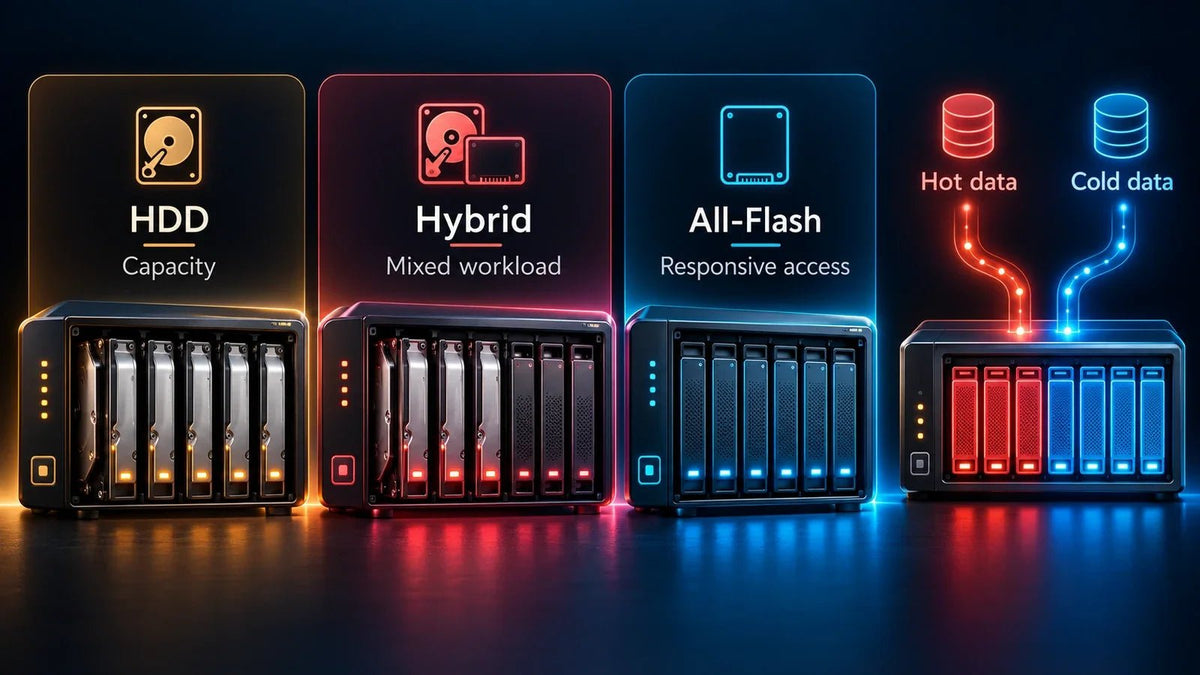
Use HDDs when affordable capacity is the main requirement, and SSDs when the working data needs faster response. NVMe can provide a higher performance ceiling, but the client, network, NAS and workload must be able to use it. Add cache or tiering only for a defined access pattern; neither automatically makes every file transfer faster.
A full-flash NAS looks tempting when a progress bar is moving slowly. Yet a 1GbE connection can hold back a much faster storage array, while an office opening thousands of small files may care more about response time than a large-copy speed.
The value question is therefore specific: which part of the job is slow, how much of the data is active, and what is the least complicated change that solves it?
HDD, SATA SSD and NVMe: What Each Buys You
| Storage Choice | Where It Often Fits | What to Budget For | Important Limit |
|---|---|---|---|
| HDD pool | Large archives, backup repositories and capacity-heavy file storage. | Enough drives, suitable protection, spare working space and backup. | Mechanical seek behaviour matters with many small random requests. |
| SATA SSD pool | Active shared work, application data and workloads needing quicker random access. | Capacity, endurance, supported drives and the required redundancy. | Drive interface, NAS processing and network can become the next limit. |
| NVMe pool | A demanding active workload on a compatible NAS and sufficiently fast network. | Supported slots, PCIe resources, cooling, endurance and the complete data path. | An M.2 shape or NVMe label does not guarantee the same bandwidth in every NAS. |
| HDD plus SSD acceleration | A suitable frequently accessed working set alongside a larger capacity pool. | Correct cache or tiering mode, RAM, compatible SSDs and monitoring. | The benefit depends on how the data is accessed and where it resides. |
No row is the universal winner. A large HDD array serving sequential data can be a better-value purchase than a small flash array that cannot hold the project and its required protection.
Check the Network Ceiling Before Buying Flash
Divide the Ethernet rate in bits per second by eight to obtain its raw decimal byte rate. That gives 125 MB/s for 1GbE, 312.5 MB/s for 2.5GbE and 1,250 MB/s for 10GbE. Protocol overhead and the rest of the system reduce useful file-copy throughput.
The Whole File-Transfer Path Has to Keep Up
- Computer / Adapter
- Switch / Uplink
- NAS Network
- Storage Pool
A faster storage pool cannot push a file through a slower negotiated link. Check the computer's network adapter, switch and NAS ports, plus any USB adapter or shared uplink. If the connection has fallen to 100 Mb/s, fix that before comparing SSD brands.
The 100 Mb/s Ethernet checklist helps find that fault. For a wider diagnosis, use the NAS file-transfer troubleshooting guide.
What a Faster Copy Means for a 100 GB Project
Turn the rate into time. For a decimal 100 GB file set, divide 100,000 MB by the sustained transfer rate. If a copy maintains the example rates below, the arithmetic is:
| Example Sustained Rate | Calculation | Time for 100 GB |
|---|---|---|
| 100 MB/s | 100,000 ÷ 100 | 16 min 40 sec |
| 250 MB/s | 100,000 ÷ 250 | 6 min 40 sec |
| 900 MB/s | 100,000 ÷ 900 | About 1 min 51 sec |
These are calculated times at stated rates, not product benchmark results. Small-file overhead, source and destination storage, background work and network sharing change the observed copy. Measure a representative job before putting the saved time into a business case.

Cache, Tiering and an SSD Pool Are Different Choices
SSD Cache
A smaller acceleration layer for selected data access. Read cache keeps copies; a write-back cache has additional protection and recovery considerations.
Tiered Storage
Moves data between storage tiers according to the supported policy. The SSD tier is part of the storage design, not simply another independent backup.
SSD Storage Pool
The active files or applications live on SSD-backed storage. Its capacity, protection and independent backup must cover that data.
Cache is most interesting when useful data is revisited often enough to benefit. A first pass through a large new media collection is different from repeatedly opening the same application data. Synology's guidance highlights this distinction: large sequential workloads without repeated access may see little benefit from SSD cache.
Tiering also needs version-specific care. QNAP's current documentation lists automatic Qtier on QTS and scheduled tiering on supported QuTS hero releases. Older advice saying QuTS hero never supports tiering misses the h6.0 change. Check the exact NAS, release and configuration before allocating drives.
For a predictable active-project workflow, a separate supported SSD pool can make the data's location easier to understand. That simplicity may be more valuable than combining several acceleration layers without measurements.
Three Workloads, Three Sensible Starting Points
A Large Photo Archive and Routine Backups
Start with HDD capacity, enough usable space and a tested independent copy. Spend on the phone-import and recovery workflow before adding flash. A modest active library may benefit from other resources first; measure the indexing or browsing bottleneck.
A Studio with Large Active Projects
Map the active project separately from the archive. Compare a complete faster network and suitable SSD working space with a capable HDD design. Keep completed projects on an appropriate capacity tier and retain a separate backup. Do not let an improvised move between “fast” and “archive” folders become the only copy.
Several Applications or Virtual Machines
Look beyond sequential MB/s. Random access, latency, concurrent jobs, memory and write endurance can justify SSD or NVMe storage even when a single large-copy test looks acceptable. Use the application workload and recovery requirement to choose the pool and protection.
Compare Cost per Usable TB, Then Add the Whole System
Use equal requirements when comparing quotations. Four 8 TB drives provide 32 TB raw. RAID 5 allocates roughly one drive's capacity to parity, leaving 24 TB nominal data capacity before formatting and other reservations. A different protection layout changes that figure.
Next deduct the capacity you intend to leave free and allow for snapshots or versions. A quote for 32 TB raw and a quote for 32 TB usable are not equivalent. Use the RAID calculator to compare the layouts.
Storage cost per planned usable TB = comparable storage-system cost ÷ capacity available for the planned data. Use the same currency, tax basis, support period and protection level for both quotations. Keep the independent backup cost visible rather than silently dropping it from the cheaper option.
- NAS enclosure, supported memory and compatible drives.
- Network adapters, switch ports, modules and cabling needed to achieve the target.
- Independent backup storage, retention and applicable software or cloud charges.
- UPS, installation, migration, support and operating power.
Product links provide current offers; a fixed old dollar-per-TB table can hide changes in capacity, endurance, currency and included equipment.
Examples of Different Storage Platforms

These are different platform approaches, not a measured head-to-head test. Check the qualified drives, required software and network around each. An NVMe NAS is worthwhile when the workload can use its response and bandwidth; a hybrid-capable tower may be a better match for substantial capacity and a smaller active set.
Measure Once Before Buying the Next Layer
- Record the negotiated link and a wired baseline.
- Copy one large file set and one representative small-file project.
- Watch CPU, memory, disk activity and other jobs during the slowdown.
- For cache, review working-set size and hit behaviour after normal use.
- Change one justified component, repeat the same task and retain the recovery test.
For a new system rather than an upgrade, the NAS buying checklist covers the complete requirements brief.
Frequently Asked Questions
Is an SSD NAS always better than an HDD NAS?
It can provide quicker random access, but capacity, cost, endurance and the rest of the system still matter. A well-sized HDD design can be the better match for a large archive or backup repository.
Will NVMe cache make every file copy faster?
No. The benefit depends on the access pattern, useful working set, cache mode and platform. A slower network or a one-time sequential copy may remain the main limit.
Does QuTS hero support Qtier?
Supported QuTS hero h6.0 and later systems introduced tiering support. Current QNAP guidance distinguishes scheduled tiering on QuTS hero from automatic tiering on QTS. Confirm the exact release, hardware and supported layout.
Do two 2.5GbE ports automatically make one 5Gbps file copy?
No. Multiple links, link aggregation and SMB Multichannel are different arrangements. The clients, server, protocol and configuration must support the intended path; do not add port labels together as a single-transfer guarantee.
How should I compare cost per TB?
Use planned usable capacity after the protection layout, reservations and working-space allowance. Compare the same currency, tax basis, support scope and recovery requirement, and keep the independent backup visible.
Should one editor use a NAS or a directly attached SSD?
A directly attached SSD can be a simple option for one computer's active work. A NAS adds network sharing, permissions and supported central services. Choose around collaboration, capacity and recovery rather than assuming one connection type suits every project.
Spend on the Bottleneck That Costs You Time
For affordable capacity, start with a suitable HDD design. For an active workload that needs quicker response, compare supported SATA SSD and NVMe pools. Use cache or tiering when the access pattern and supported platform justify it.
Keep enough usable space, complete the network path and retain an independent recovery copy. The best-value NAS is the one that finishes the required work reliably, without an expensive layer that the rest of the system cannot use.


