







Ubiquiti UniFi EAV-XG-24-PoE Enterprise AV Switch
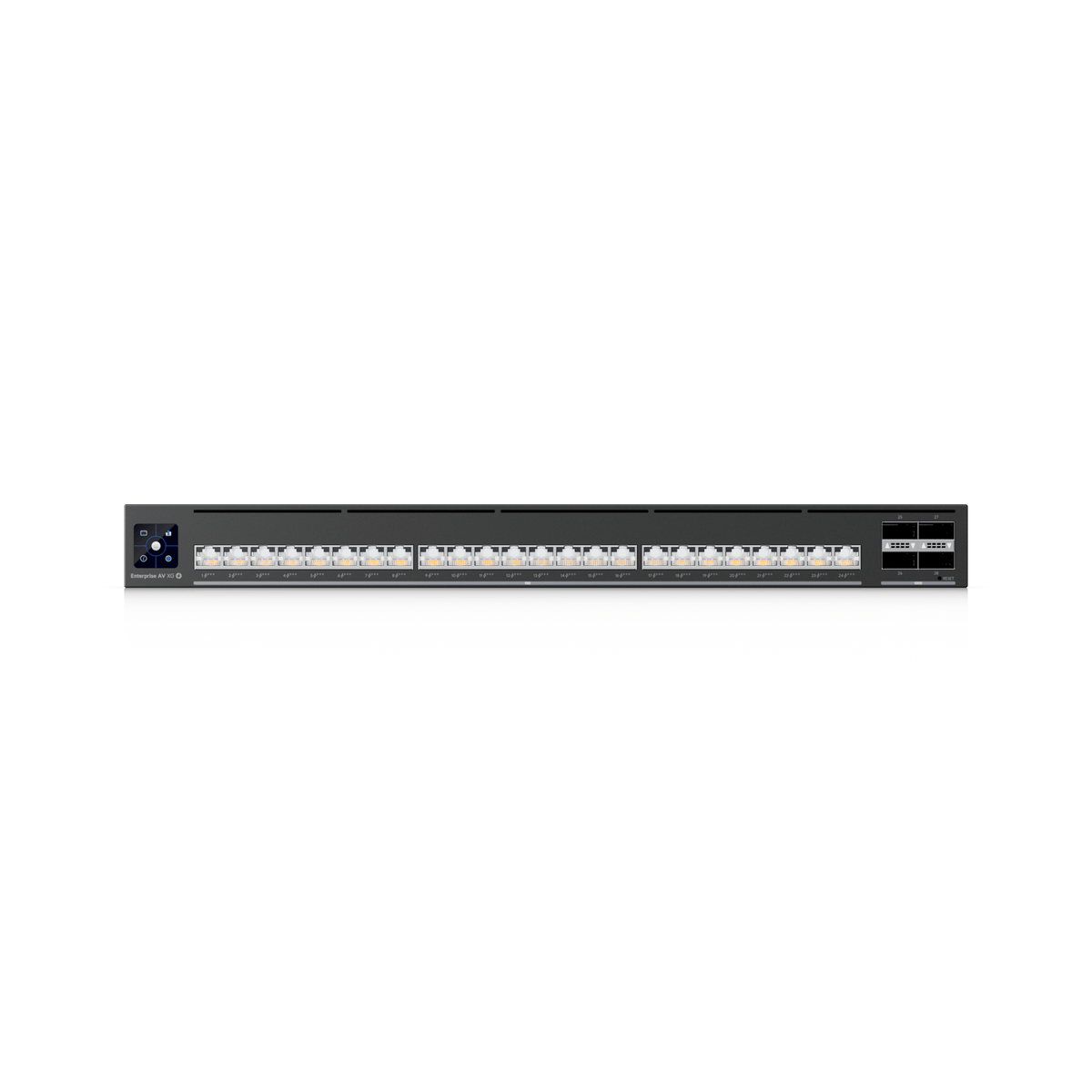
Power and Precision for Professional AV Bring media transport, endpoint power and precise network timing together in one rack. The UniFi EAV-XG-24-PoE connects 24 multi-gigabit copper devices, provides four 100G uplinks and supports hardware-based PTP for professional audio and video. It suits AV installations that need deliberate clocking, multicast control and high-power PoE, with power-sharing or redundant operation selected to match the installation. Highlights High-Capacity AV Connections 24 multi-gigabit 10GbE RJ45 ports with up to 90 W PoE+++ per port. Four 100G/40G QSFP28 uplinks and 1,280 Gbps switching capacity. A Shared Timing Foundation Hardware-timestamped PTPv2 with Grandmaster, Boundary and Transparent clock roles. OCXO clock, professional timing profiles and an optional external GPS reference. Prepared for the Rack Two 1,200 W hot-swappable power modules and four replaceable fan modules. Included rack rails, Etherlighting port identification and a local touchscreen. Key Features Connect AV Endpoints at Their Native Speed Each of the 24 copper ports supports 10G, 5G, 2.5G, 1G, 100M and 10M connections. This lets a rack serve a mixture of high-bandwidth media equipment and lower-speed control devices without reducing every port to the same speed. The four QSFP28 uplinks support 100G or 40G connections for the paths carrying traffic between switches. Budget Power for the Operating Mode All 24 copper ports support PoE+++ with up to 90 W per port, subject to the total available budget. With both 1,200 W modules and 200–240 V AC input, Shared mode provides up to 2,150 W of PoE; Redundant mode provides 1,050 W. At 100–120 V, those totals are 1,850 W and 850 W. Select the mode and size the connected load together rather than treating the headline budget as available in every installation. Give Audio and Video a Consistent Clock Hardware-based PTPv2 provides the timing functions needed by compatible AES67 and SMPTE ST 2110 systems. Choose Grandmaster, Boundary or Transparent operation to suit the topology, then use matching profiles and timing parameters across the domain. The internal OCXO clock and optional external GPS reference support a considered timing design; the switch does not remove the need to configure the endpoints correctly. Make Multicast and QoS Part of the Plan Pro AV port profiles help prioritise supported audio, video and control traffic, while IGMP snooping, querier and fast-leave controls manage multicast distribution. Apply the appropriate settings to every port carrying the media, including links between switches. PTP uses the native VLAN and is not supported across aggregated ports, so timing paths need to be planned separately from a general LACP design. Keep Local Routing Close to the Media Layer 3 functions include local-network inter-VLAN routing, static routes, DHCP server and DHCP relay. VLANs, access lists and port isolation help separate the AV system from other traffic while preserving the connections it actually needs. These are switch routing and segmentation functions, not a substitute for the wider network’s security design or internet gateway. Service Power and Cooling in the Rack Two hot-swappable power modules and four hot-swappable fans make the power and cooling components accessible for maintenance. Fan modules operate with 3+1 redundancy. Choose Redundant power mode when the design needs a power-module failure allowance, and keep the PoE load within that mode’s lower budget. Shared mode’s higher output is a different operating choice. Install with Full-Depth Support The 1U chassis is 480 mm deep and is supplied with rack rails. Use a suitable 19-inch four-post rack with 650–1,000 mm post spacing; a two-post installation needs a centre-mount bracket or cantilever shelf for proper support. Etherlighting and the touchscreen help identify ports and inspect the equipment after it is installed. Summary The EAV-XG-24-PoE brings powered copper AV endpoints and high-capacity uplinks into the same managed timing environment. Its value lies in combining multi-gigabit PoE+++, hardware PTP, multicast controls and serviceable rack hardware, with clearly defined power and installation requirements. Frequently Asked Questions Is the Full 2,150 W PoE Budget Always Available?ExpandCollapse No. The 2,150 W total applies with both 1,200 W modules, 200–240 V AC input and Shared mode. Redundant mode at that voltage provides 1,050 W. At 100–120 V AC, the totals are 1,850 W Shared or 850 W Redundant. Each port is also limited to its supported PoE rating, up to 90 W. Can I Use Link Aggregation for a PTP Timing Path?ExpandCollapse LACP is supported for ordinary switch traffic, but PTPv2 is not supported over aggregated ports. PTP operates on the native VLAN. Plan direct suitable uplinks and a consistent clock profile for the AV timing domain rather than assuming an aggregated link carries the same timing support. Does It Replace an AV Encoder or Decoder?ExpandCollapse No. This switch transports and manages compatible network traffic, power and timing. Cameras, HDMI or audio sources and displays still need compatible AV-over-IP endpoints, such as a suitable transmitter or receiver. Select the profiles and multicast settings that match the actual equipment. Are the Power Modules and Rack Rails Included?ExpandCollapse The current manufacturer configuration includes two 1,200 W hot-swappable power modules and rack rails. A four-post rack must provide 650–1,000 mm post spacing. For a two-post rack, use suitable additional centre support or a cantilever shelf. The rack itself is not included. Is This Different Hardware from EAV-24-PoE?ExpandCollapse Ubiquiti identifies EAV-XG-24-PoE as the updated name for EAV-24-PoE and states that the naming change does not alter the hardware. Check the installed configuration and current firmware when planning an existing deployment.
Add-ons (5)
Pickup available at 3005, Ubi Avenue 3, #01-88
通常2〜4日で準備が完了します
Ubiquiti UniFi EAV-XG-24-PoE Enterprise AV Switch
商品説明
Power and Precision for Professional AV
Bring media transport, endpoint power and precise network timing together in one rack. The UniFi EAV-XG-24-PoE connects 24 multi-gigabit copper devices, provides four 100G uplinks and supports hardware-based PTP for professional audio and video. It suits AV installations that need deliberate clocking, multicast control and high-power PoE, with power-sharing or redundant operation selected to match the installation.
Highlights
High-Capacity AV Connections
- 24 multi-gigabit 10GbE RJ45 ports with up to 90 W PoE+++ per port.
- Four 100G/40G QSFP28 uplinks and 1,280 Gbps switching capacity.
A Shared Timing Foundation
- Hardware-timestamped PTPv2 with Grandmaster, Boundary and Transparent clock roles.
- OCXO clock, professional timing profiles and an optional external GPS reference.
Prepared for the Rack
- Two 1,200 W hot-swappable power modules and four replaceable fan modules.
- Included rack rails, Etherlighting port identification and a local touchscreen.
Key Features
Connect AV Endpoints at Their Native Speed
Each of the 24 copper ports supports 10G, 5G, 2.5G, 1G, 100M and 10M connections. This lets a rack serve a mixture of high-bandwidth media equipment and lower-speed control devices without reducing every port to the same speed. The four QSFP28 uplinks support 100G or 40G connections for the paths carrying traffic between switches.
Budget Power for the Operating Mode
All 24 copper ports support PoE+++ with up to 90 W per port, subject to the total available budget. With both 1,200 W modules and 200–240 V AC input, Shared mode provides up to 2,150 W of PoE; Redundant mode provides 1,050 W. At 100–120 V, those totals are 1,850 W and 850 W. Select the mode and size the connected load together rather than treating the headline budget as available in every installation.
Give Audio and Video a Consistent Clock
Hardware-based PTPv2 provides the timing functions needed by compatible AES67 and SMPTE ST 2110 systems. Choose Grandmaster, Boundary or Transparent operation to suit the topology, then use matching profiles and timing parameters across the domain. The internal OCXO clock and optional external GPS reference support a considered timing design; the switch does not remove the need to configure the endpoints correctly.
Make Multicast and QoS Part of the Plan
Pro AV port profiles help prioritise supported audio, video and control traffic, while IGMP snooping, querier and fast-leave controls manage multicast distribution. Apply the appropriate settings to every port carrying the media, including links between switches. PTP uses the native VLAN and is not supported across aggregated ports, so timing paths need to be planned separately from a general LACP design.
Keep Local Routing Close to the Media
Layer 3 functions include local-network inter-VLAN routing, static routes, DHCP server and DHCP relay. VLANs, access lists and port isolation help separate the AV system from other traffic while preserving the connections it actually needs. These are switch routing and segmentation functions, not a substitute for the wider network’s security design or internet gateway.
Service Power and Cooling in the Rack
Two hot-swappable power modules and four hot-swappable fans make the power and cooling components accessible for maintenance. Fan modules operate with 3+1 redundancy. Choose Redundant power mode when the design needs a power-module failure allowance, and keep the PoE load within that mode’s lower budget. Shared mode’s higher output is a different operating choice.
Install with Full-Depth Support
The 1U chassis is 480 mm deep and is supplied with rack rails. Use a suitable 19-inch four-post rack with 650–1,000 mm post spacing; a two-post installation needs a centre-mount bracket or cantilever shelf for proper support. Etherlighting and the touchscreen help identify ports and inspect the equipment after it is installed.
Summary
The EAV-XG-24-PoE brings powered copper AV endpoints and high-capacity uplinks into the same managed timing environment. Its value lies in combining multi-gigabit PoE+++, hardware PTP, multicast controls and serviceable rack hardware, with clearly defined power and installation requirements.
Frequently Asked Questions
Is the Full 2,150 W PoE Budget Always Available?
No. The 2,150 W total applies with both 1,200 W modules, 200–240 V AC input and Shared mode. Redundant mode at that voltage provides 1,050 W. At 100–120 V AC, the totals are 1,850 W Shared or 850 W Redundant. Each port is also limited to its supported PoE rating, up to 90 W.
Can I Use Link Aggregation for a PTP Timing Path?
LACP is supported for ordinary switch traffic, but PTPv2 is not supported over aggregated ports. PTP operates on the native VLAN. Plan direct suitable uplinks and a consistent clock profile for the AV timing domain rather than assuming an aggregated link carries the same timing support.
Does It Replace an AV Encoder or Decoder?
No. This switch transports and manages compatible network traffic, power and timing. Cameras, HDMI or audio sources and displays still need compatible AV-over-IP endpoints, such as a suitable transmitter or receiver. Select the profiles and multicast settings that match the actual equipment.
Are the Power Modules and Rack Rails Included?
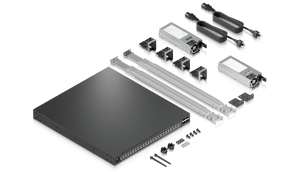
The current manufacturer configuration includes two 1,200 W hot-swappable power modules and rack rails. A four-post rack must provide 650–1,000 mm post spacing. For a two-post rack, use suitable additional centre support or a cantilever shelf. The rack itself is not included.
Is This Different Hardware from EAV-24-PoE?
Ubiquiti identifies EAV-XG-24-PoE as the updated name for EAV-24-PoE and states that the naming change does not alter the hardware. Check the installed configuration and current firmware when planning an existing deployment.
仕様
Ubiquiti UniFi EAV-XG-24-PoE Enterprise AV Switch
The UniFi EAV-XG-24-PoE combines high-speed copper access, 100G uplinks and hardware-based clock synchronisation for professional AV networks. Its 24 powered ports support mixed endpoint speeds, while PTP roles and multicast controls help establish the timing and traffic paths. Two power modules and rack rails are included. PoE availability depends on AC voltage and the selected power mode, so endpoint loads, power feeds, rack support and the timing topology should be considered together.
| Specification | Details |
|---|---|
| Connections and Capacity | |
| Powered Copper Ports | 24 × 10GbE RJ45, each supporting 10G/5G/2.5G/1G/100M/10M and PoE+++. 10/100 Mb/s half-duplex is not supported. |
| High-Speed Uplinks | 4 × QSFP28 supporting 100G/40G. Breakout cables are not supported. |
| Management and Console | 1 × 1GbE RJ45 management interface (1G/100M/10M), one console connection and one SMA GPS input. |
| Switching Capacity | 1,280 Gbps; 640 Gbps total non-blocking throughput; 810 Mpps forwarding rate. |
| PoE and Electrical Power | |
| PoE Output per Port | Up to 15.4 W PoE, 30 W PoE+, 60 W PoE++ or 90 W PoE+++ by the PSE; total budget also applies. |
| PoE Budget at 200–240 V AC | Shared mode up to 2,150 W; Redundant mode up to 1,050 W, with two 1,200 W modules. |
| PoE Budget at 100–120 V AC | Shared mode up to 1,850 W; Redundant mode up to 850 W, with two 1,200 W modules. |
| Included Power Supply | 2 × hot-swappable AC/DC 1,200 W modules with two AC inputs; 100–240 V AC, 50/60 Hz. |
| Maximum Consumption | 150 W excluding PoE output; 2,400 W including PoE output. |
| Heat Dissipation | 512 BTU/hr excluding PoE output. |
| PTP and AV Timing | |
| Timing Protocol | IEEE 1588-2008 PTPv2 with hardware timestamping on all Ethernet and QSFP28 ports. |
| Clock Roles | Grandmaster, Boundary Clock and Transparent Clock; Boundary Clock uses two-step operation only. |
| Timing Profiles | IEEE 1588, SMPTE 2059-2, AES67 and AES-R16. |
| Timing Transport | Layer 2 Ethernet or UDP/IPv4 with the End-to-End delay mechanism. |
| Custom Timing Controls | Sync, Announce and Delay Request intervals from −3 to +4; Announce Receipt Timeout from 2 to 9; configurable PTP domain and BMCA Priority1/Priority2. |
| PTP Design Requirements | PTP operates on the native VLAN and is not supported over aggregated ports. Use consistent profiles and parameters throughout the timing domain. |
| Clock Reference | High-precision OCXO clock and one SMA connection for an optional external GPS grandmaster reference. |
| Routing and Traffic Control | |
| Layer 3 Functions | Local-network inter-VLAN and static routing, DHCP server and DHCP relay. |
| Network Scale | Up to 1,000 VLANs, 32,000 MAC addresses and 512 IPv4 static routes; 8 MB packet buffer. |
| Access Lists | 256 IPv4 ACL entries and 256 MAC ACL entries. |
| AV Traffic Profiles | Pro AV profiles for Play, Dante, Q-SYS, NDI, SDVoE, Shure, AES67 and Crestron. |
| Multicast Controls | IGMP snooping, querier, fast leave and router-port configuration. Match the settings to the AV protocol and topology. |
| Switching and QoS | LACP, STP/RSTP, DSCP QoS, flow control, storm control, multicast/broadcast rate limiting, jumbo frames, LLDP-MED and voice VLAN. |
| Network Protection | 802.1X, MAC/IP ACLs, device and port isolation, DHCP snooping/guarding, MAC-based port restrictions and loop protection. |
| Monitoring and Port Controls | Port mirroring, egress rate limits, MAC address blocking and virtual network override. |
| Chassis and Installation | |
| Form Factor | 1U full-depth rackmount chassis; SGCC steel enclosure and mounting hardware. |
| Dimensions | 442.4 × 480 × 43.7 mm (width × depth × height). |
| Rack Support | 19-inch four-post rack with 650–1,000 mm post spacing. A two-post rack needs a suitable centre-mount bracket or cantilever shelf for support. |
| Cooling | Four hot-swappable fan modules with 3+1 redundancy. |
| Local Display | 1.3-inch touchscreen. |
| Management | UniFi Network management, Ethernet, AR and serial console. Use a supported current UniFi Network and switch firmware release. |
| Operating Conditions | −5 to 40 °C; 10–90% relative humidity, non-condensing. |
| Compliance | CE, FCC and IC; manufacturer lists NDAA compliance. |
| Product Weight | 9.85 kg without mounting brackets; 9.95 kg with mounting brackets. |
| ESD Protection | Air ±2 kV; contact ±8 kV. |
| Port and Component Indicators | Etherlighting on Ethernet and QSFP28; status LEDs for Ethernet, power modules and fans. |
| Supplied Equipment | |
| Included Equipment | Switch, two power modules, four fan modules, rack rail components, mounting hardware and power cords. |
| Separately Selected Equipment | Rack, compatible optical modules or DACs, network cables, AV endpoints and optional external GPS reference equipment. |
Add-ons


Ubiquiti EAV-Bridge Enterprise 4K60 HDMI and XLR Audio AV-over-IP PoE+ Transceiver


Ubiquiti UACC-Cable-Patch-EL-C6A UniFi CAT6A プレミアムパッチケーブル


Ubiquiti UACC-DAC-QSFP28 100G QSFP28 and QSFP+ Direct Attach Cable


