

QNAP TS-h973AX 9-Bay Tower NAS
Fast SSD Storage Beside High-Capacity Files The QNAP TS-h973AX combines five HDD-sized SATA bays with four dedicated 2.5-inch positions in a compact business tower. Two of those SSD positions also support U.2 NVMe, while built-in 10GbE and dual 2.5GbE connect shared storage to suitable workstations and network equipment without an extra network card. Highlights A Genuine Hybrid Layout Five larger SATA bays plus four 2.5-inch SSD positions U.2 NVMe PCIe Gen 3 x4 supported only in SSD bays 1 and 2 Included Multi-Gig Networking One 10GBASE-T port and two 2.5GbE ports USB 3.2 Gen 2 Type-A and Type-C connections Choose the Memory Configuration AMD Ryzen Embedded V1500B, 4 cores and 8 threads Selectable factory memory with supported upgrades to 64GB Key Features Keep the Bay Interfaces Clear Five larger bays provide the SATA HDD/SSD side of the design. The four smaller positions accommodate compatible SATA SSDs, with only SSD bays 1 and 2 also wired for U.2 NVMe. The remaining two SSD positions do not accept U.2 drives. There are no onboard M.2 slots or PCIe expansion slots, so choose the actual supported drive format. Use the Included 10GbE Connection The built-in 10GBASE-T port supports multiple Ethernet link speeds, alongside two 2.5GbE ports. This provides connection options for a suitable switch or workstation without adding an internal network card. Network equipment, cabling, drive configuration and concurrent work determine useful throughput. Select Memory for the Applications Choose the factory memory option that suits the intended services. QNAP recommends at least 16GB when planning memory-intensive workloads such as virtual machines and several collaboration or management applications. Supported upgrades can reach 64GB, with identical DDR4 modules required in a two-module configuration; optional ECC memory is a separate configuration choice. Use ZFS With a Defined Backup Plan QuTS hero provides a ZFS environment with supported integrity checks, compression, snapshots and data-protection functions. Deduplication and application workloads need sufficient memory. QTS is an alternative supported OS with EXT4. An OS change requires reinitialisation and backup, while RAID and snapshots do not replace an independent copy of important files. Expand Through USB Supported TR and TL USB enclosures provide additional storage options without an internal expansion card. Choose the exact enclosure, supported cable and operating mode before installation. USB expansion has separate storage-pool restrictions, so do not assume that an enclosure can extend every existing internal pool. Separate Recording From Analytics Camera recording capacity depends on the installed memory, drive design and recording settings. Playback, AI analysis and other NAS services use additional resources. The published planning figures use a recording-only QTS scenario; expanded QuTS hero recording entitlement must be confirmed separately rather than inferred from an estimate. Summary The TS-h973AX is a compact hybrid choice when HDD capacity, U.2 SSD capability and included 10GbE belong in one system. Select the memory option and exact SSD interface first, then plan data protection, USB expansion and application resources around the intended workload. Frequently Asked Questions Are Drives Included?ExpandCollapse No. This is a diskless NAS. 5 × 3.5-inch SATA HDD/2.5-inch SATA SSD bays plus 4 × 2.5-inch SSD bays; SSD bays 1/2 support SATA or U.2 NVMe PCIe Gen 3 x4; SSD bays 3/4 are SATA only. Select the exact compatible drive, interface and firmware before ordering; usable capacity is lower after RAID and system overhead. Which Network Ports Are Included?ExpandCollapse 1 × 10GBASE-T RJ45, 10G/5G/2.5G/1G/100M; 2 × 2.5GbE RJ45, 2.5G/1G/100M. Check the clients, switches and cabling as well as the NAS; interface speed is not a guaranteed file-transfer rate. Which Expansion Units Can I Use?ExpandCollapse up to 2 × TL-D800C, TL-R1200C-RP, TR-002, TR-004, TR-004U. This model has no PCIe expansion slot, so SATA/SAS controller-based enclosures are not an internal-card upgrade route. Enclosure counts are per listed type, not additive when mixing units. Verify OS, firmware and storage-pool restrictions. How Many Cameras Can It Record?ExpandCollapse QNAP’s QVR Surveillance planning estimate on QTS is 8GB: 57 channels; 32GB: 114 channels. This uses 5 main SATA drives in RAID 6; dedicated SSD positions excluded. 1080p, H.264, 30fps, 4.096Mb/s per camera; recording only, without playback or AI analytics. It is not a tested or guaranteed maximum. QVR Surveillance provides 2 included channels plus 6 after registration; compatible paid licences are required above 8. Expanded QuTS hero recording channels remain listed as developing and need separate confirmation. Can I Upgrade the Memory?ExpandCollapse Factory 8GB (1 × 8GB) or 32GB (2 × 16GB) DDR4 SODIMM, according to selected option; 2 slots; optional supported ECC memory. 64GB with 2 × 32GB supported modules; use identical modules for two-DIMM configurations. For memory-intensive QuTS hero applications, QNAP recommends at least 16GB. Check the exact QNAP-supported module and installation rules; changing memory does not guarantee an application performance level. Does RAID Replace a Backup?ExpandCollapse No. RAID can provide configured drive redundancy, but it does not prevent every deletion, ransomware event, theft or enclosure failure. Keep an independent, current backup and test that important files can be restored.
追加商品 (3)
3005, Ubi Avenue 3, #01-88で受け取り可能
通常2〜4日で準備が完了します
QNAP TS-h973AX 9-Bay Tower NAS
商品説明
Fast SSD Storage Beside High-Capacity Files
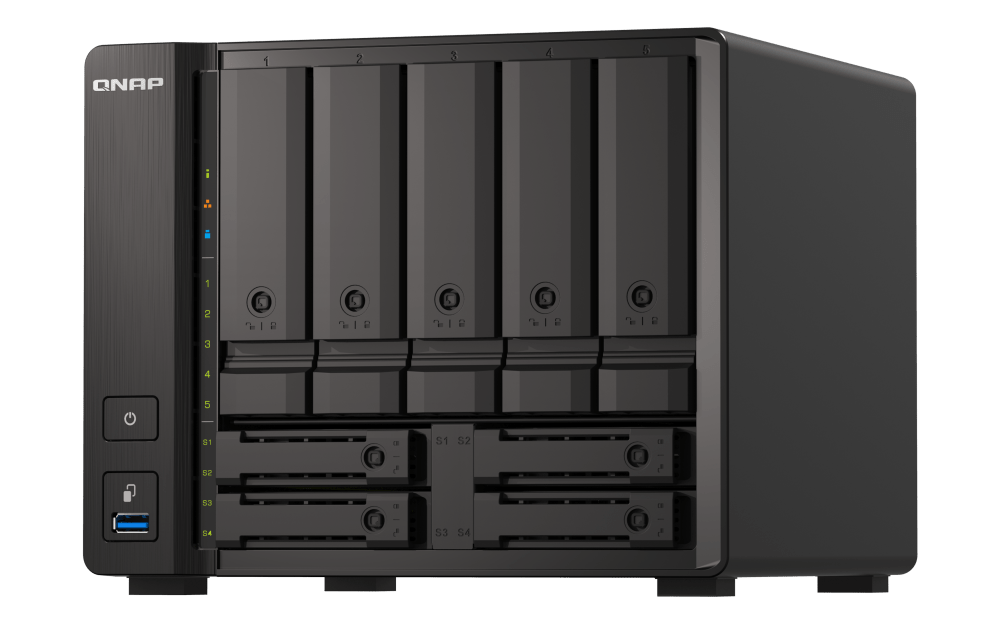
The QNAP TS-h973AX combines five HDD-sized SATA bays with four dedicated 2.5-inch positions in a compact business tower. Two of those SSD positions also support U.2 NVMe, while built-in 10GbE and dual 2.5GbE connect shared storage to suitable workstations and network equipment without an extra network card.
Highlights
A Genuine Hybrid Layout
- Five larger SATA bays plus four 2.5-inch SSD positions
- U.2 NVMe PCIe Gen 3 x4 supported only in SSD bays 1 and 2
Included Multi-Gig Networking
- One 10GBASE-T port and two 2.5GbE ports
- USB 3.2 Gen 2 Type-A and Type-C connections
Choose the Memory Configuration
- AMD Ryzen Embedded V1500B, 4 cores and 8 threads
- Selectable factory memory with supported upgrades to 64GB
Key Features
Keep the Bay Interfaces Clear
Five larger bays provide the SATA HDD/SSD side of the design. The four smaller positions accommodate compatible SATA SSDs, with only SSD bays 1 and 2 also wired for U.2 NVMe. The remaining two SSD positions do not accept U.2 drives. There are no onboard M.2 slots or PCIe expansion slots, so choose the actual supported drive format.
Use the Included 10GbE Connection
The built-in 10GBASE-T port supports multiple Ethernet link speeds, alongside two 2.5GbE ports. This provides connection options for a suitable switch or workstation without adding an internal network card. Network equipment, cabling, drive configuration and concurrent work determine useful throughput.
Select Memory for the Applications
Choose the factory memory option that suits the intended services. QNAP recommends at least 16GB when planning memory-intensive workloads such as virtual machines and several collaboration or management applications. Supported upgrades can reach 64GB, with identical DDR4 modules required in a two-module configuration; optional ECC memory is a separate configuration choice.
Use ZFS With a Defined Backup Plan
QuTS hero provides a ZFS environment with supported integrity checks, compression, snapshots and data-protection functions. Deduplication and application workloads need sufficient memory. QTS is an alternative supported OS with EXT4. An OS change requires reinitialisation and backup, while RAID and snapshots do not replace an independent copy of important files.
Expand Through USB
Supported TR and TL USB enclosures provide additional storage options without an internal expansion card. Choose the exact enclosure, supported cable and operating mode before installation. USB expansion has separate storage-pool restrictions, so do not assume that an enclosure can extend every existing internal pool.
Separate Recording From Analytics
Camera recording capacity depends on the installed memory, drive design and recording settings. Playback, AI analysis and other NAS services use additional resources. The published planning figures use a recording-only QTS scenario; expanded QuTS hero recording entitlement must be confirmed separately rather than inferred from an estimate.
Summary
The TS-h973AX is a compact hybrid choice when HDD capacity, U.2 SSD capability and included 10GbE belong in one system. Select the memory option and exact SSD interface first, then plan data protection, USB expansion and application resources around the intended workload.
Frequently Asked Questions
Are Drives Included?
No. This is a diskless NAS. 5 × 3.5-inch SATA HDD/2.5-inch SATA SSD bays plus 4 × 2.5-inch SSD bays; SSD bays 1/2 support SATA or U.2 NVMe PCIe Gen 3 x4; SSD bays 3/4 are SATA only. Select the exact compatible drive, interface and firmware before ordering; usable capacity is lower after RAID and system overhead.
Which Network Ports Are Included?
1 × 10GBASE-T RJ45, 10G/5G/2.5G/1G/100M; 2 × 2.5GbE RJ45, 2.5G/1G/100M. Check the clients, switches and cabling as well as the NAS; interface speed is not a guaranteed file-transfer rate.
Which Expansion Units Can I Use?
up to 2 × TL-D800C, TL-R1200C-RP, TR-002, TR-004, TR-004U. This model has no PCIe expansion slot, so SATA/SAS controller-based enclosures are not an internal-card upgrade route. Enclosure counts are per listed type, not additive when mixing units. Verify OS, firmware and storage-pool restrictions.
How Many Cameras Can It Record?
QNAP’s QVR Surveillance planning estimate on QTS is 8GB: 57 channels; 32GB: 114 channels. This uses 5 main SATA drives in RAID 6; dedicated SSD positions excluded. 1080p, H.264, 30fps, 4.096Mb/s per camera; recording only, without playback or AI analytics. It is not a tested or guaranteed maximum. QVR Surveillance provides 2 included channels plus 6 after registration; compatible paid licences are required above 8. Expanded QuTS hero recording channels remain listed as developing and need separate confirmation.
Can I Upgrade the Memory?
Factory 8GB (1 × 8GB) or 32GB (2 × 16GB) DDR4 SODIMM, according to selected option; 2 slots; optional supported ECC memory. 64GB with 2 × 32GB supported modules; use identical modules for two-DIMM configurations. For memory-intensive QuTS hero applications, QNAP recommends at least 16GB. Check the exact QNAP-supported module and installation rules; changing memory does not guarantee an application performance level.
Does RAID Replace a Backup?
No. RAID can provide configured drive redundancy, but it does not prevent every deletion, ransomware event, theft or enclosure failure. Keep an independent, current backup and test that important files can be restored.
仕様
QNAP TS-h973AX 9-Bay Tower NAS
The QNAP TS-h973AX is a nine-bay hybrid tower NAS with five larger SATA bays and four dedicated SSD positions. Two SSD bays additionally accept U.2 NVMe drives, while an AMD Ryzen Embedded processor, expandable DDR4 memory, built-in 10GbE and dual 2.5GbE support shared storage and suitable applications. It has no onboard M.2 or PCIe expansion slot. QuTS hero and QTS provide alternative storage environments, and supported USB enclosures offer an external expansion route.
| Specification | Details |
|---|---|
| System and Memory | |
| Processor | AMD Ryzen Embedded V1500B; 4 cores/8 threads, 2.2GHz; 64-bit x86; AES-NI |
| Installed Memory | Factory 8GB (1 × 8GB) or 32GB (2 × 16GB) DDR4 SODIMM, according to selected option; 2 slots; optional supported ECC memory |
| Maximum Memory | 64GB with 2 × 32GB supported modules; use identical modules for two-DIMM configurations |
| Flash Memory | 5GB with dual-boot OS protection |
| Drives and Expansion | |
| Internal Drive Layout | 5 × 3.5-inch SATA HDD/2.5-inch SATA SSD bays plus 4 × 2.5-inch SSD bays; SSD bays 1/2 support SATA or U.2 NVMe PCIe Gen 3 x4; SSD bays 3/4 are SATA only |
| Drive Supply and Servicing | Diskless. Compatible main-bay drives are hot-swappable; SSD cache drives and internal/adapter-mounted M.2 devices are not hot-swappable. |
| M.2 NVMe | No onboard M.2 slot; compatible optional U.2-to-M.2 adapter is a separate bay-based installation |
| Compatible USB Expansion | up to 2 × TL-D800C, TL-R1200C-RP, TR-002, TR-004, TR-004U |
| U.2 Installation | U.2 NVMe fits only 2.5-inch SSD bays 1/2. Inserting a U.2 drive in the other bays can damage connectors. No onboard M.2 or PCIe expansion slot. |
| Expansion Conditions | Listed maxima apply per enclosure type and are not additive when mixing units. Verify current host, controller, cable, BIOS and OS compatibility. USB storage-pool restrictions apply; optional expansion equipment is separate. |
| Network and Interfaces | |
| Built-In Ethernet | 1 × 10GBASE-T RJ45, 10G/5G/2.5G/1G/100M; 2 × 2.5GbE RJ45, 2.5G/1G/100M |
| PCIe Expansion | No PCIe expansion slot |
| USB | 3 × USB 3.2 Gen 2 Type-A plus 1 × Type-C, 10Gb/s; Type-C does not mean Thunderbolt or USB4 |
| Network Functions | Port trunking, VLANs, jumbo frames and supported wake-on-LAN; clients, network design and protocol determine the benefit. |
| Storage and Data Protection | |
| Operating Systems | QTS with EXT4 or QuTS hero with ZFS. Switching OS requires reinitialisation and a prior backup. |
| RAID | QTS: Single, JBOD and RAID 0/1/5/6/10/50/60 where drive count permits. QuTS hero supports applicable ZFS arrangements, including triple mirror/parity. Separate HDD/SSD groups and observe model/OS rules. |
| RAID-Group Limits | New RAID 5/6/triple-parity groups and relevant RAID 50/60 subgroups support a maximum of 16 drives per group. Multiple groups can form an appropriate storage pool. |
| Integrity and Efficiency | QuTS hero: ZFS checksums, compression, supported deduplication and WORM. Feature availability, memory requirements and storage layout depend on OS. |
| Snapshots | Supported volume/shared-folder and LUN snapshots, retention, recovery and Snapshot Replica/Vault. Limits depend on OS, memory and storage configuration. |
| Backup and Synchronisation | Hybrid Backup Sync for another NAS, external storage and supported cloud destinations; Time Machine backup and Qsync file synchronisation. |
| iSCSI | Block-based thick/thin LUNs, multipath I/O and supported LUN snapshots; exact functions and limits depend on OS. |
| Access and Security | SMB/CIFS, NFS, user/group permissions, Windows ACL, 2-step verification, network access protection and supported encryption. |
| Account Limits | QTS: 4,096 local users; QuTS hero: 16,000 local users. Both list 512 local groups and 200,000 domain user/group accounts; these are account limits, not performance ratings. |
| Concurrent CIFS Connections | 2,000 manufacturer-listed connections with maximum memory; actual workload capacity and throughput vary. |
| Application Hosting | Virtualization Station and Container Station for compatible guests and containers. Reserve CPU, memory and storage for NAS services and verify application/licence requirements. |
| Video Surveillance | |
| Included Recording Channels | QVR Pro on supported QTS: 8. QVR Surveillance: 2 plus 6 after registration. These are separate app entitlements. |
| QVR Surveillance QTS Planning Estimate | 8GB: 57 channels; 32GB: 114 channels. Planning estimate, not a tested or guaranteed maximum. |
| Recording Estimate Conditions | 5 main SATA drives in RAID 6; dedicated SSD positions excluded. 1080p, H.264, 30fps, 4.096Mb/s per camera; recording only, without playback or AI analytics. Higher stream demand, playback, analytics or other NAS work can reduce capacity. |
| Additional Recording Licences | QVR Surveillance above 8 channels requires compatible paid licences. Verify camera, NAS, OS, app and licence support before deployment. |
| QVR Pro Software Ceiling | 128 channels on supported x86 systems is the application ceiling, not a tested recording rating for this NAS configuration; compatible licences are required above 8. |
| QuTS Hero Recording Boundary | The manufacturer software table lists expanded QVR Surveillance channels as developing. The QTS planning figure does not establish available QuTS hero expanded-channel licensing. |
| Physical and Environmental | |
| Form Factor and Cooling | Tower; 1 × 140mm system fan |
| Dimensions H × W × D | 176.5 × 224.6 × 224.1mm, excluding feet |
| Net Weight | 4.34kg |
| Temperature | 0–40°C operating; −20–70°C storage |
| Humidity | 5–95% RH non-condensing; maximum wet-bulb 27°C |
| Power and Supplied Equipment | |
| Power Supply | 120W external AC adapter; 100–240VAC |
| Power Consumption | 41.2W disk standby; 55.41W typical operation, manufacturer test with drives populated |
| Warranty | 3 years |
| Package Contents | NAS, 120W external AC adapter, power cord, one 10GBASE-T Ethernet cable, drive screws, two tray keys and quick installation guide; drives separate |
追加商品


NASCare Extended Warranty with Loaner Unit for 9-12 Bays