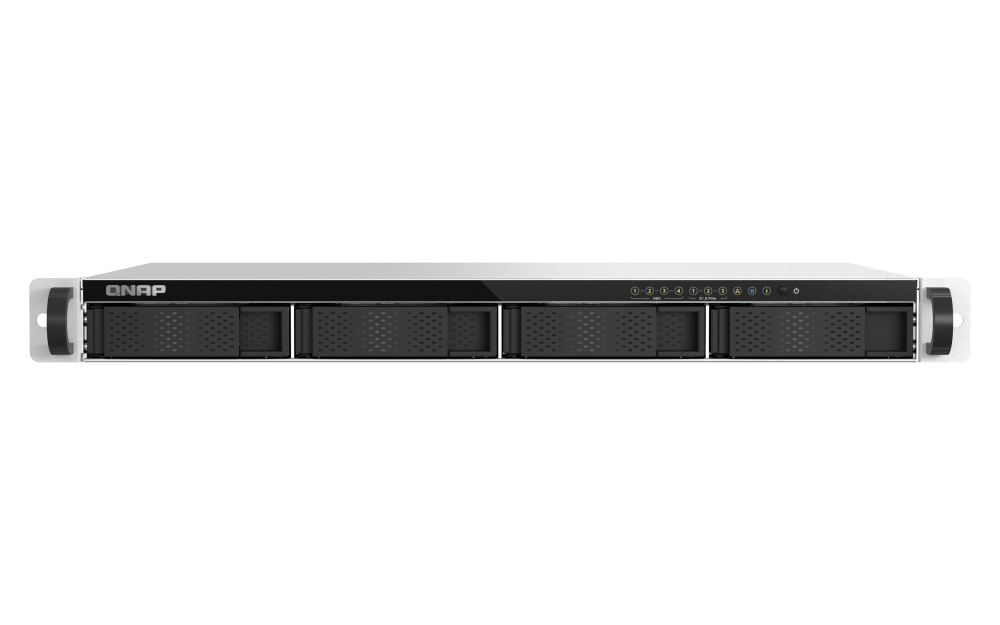


QNAP TS-h765eU 7-Bay Compact 1U Short-Depth Rackmount NAS
Business storage that fits where space is limited Bring managed business storage into a shallow rack without treating every drive position as the same thing. QNAP TS-h765eU combines four front SATA bays with three separate E1.S or M.2 NVMe positions in a compact 1U appliance. Its Intel Atom platform, DDR5 memory with in-band ECC and QuTS hero ZFS services support a considered data design for smaller offices, edge installations and media cabinets. Choose the storage roles, network upgrades and recovery plan around the available space. Highlights A compact rack installation 292.1mm chassis depth and a 1U form factor. Single 150W power supply with optional compatible rails. SATA and NVMe in distinct roles Four SATA bays plus three E1.S/M.2 NVMe positions. Preinstalled M.2 adapters; exact E1.S tray requirements apply. Managed data services QuTS hero ZFS with supported snapshots and backup tools. Dual 2.5GbE and optional E1.S 10GbE modules. Key Features Use the right drive in each position Four front bays accept qualified 3.5-inch SATA HDDs or 2.5-inch SATA SSDs. Three separate rear positions accept supported E1.S NVMe drives or M.2 2280 NVMe drives using the preinstalled adapters. They are not seven interchangeable SATA bays. Taller E1.S drives require the appropriate optional trays, and internal M.2 SSDs should not be treated as hot-swappable. Fit the installation to the cabinet The short chassis helps where full-depth rack storage would be difficult to accommodate. Check mounting-post depth, rail suitability, cable clearance, load and cooling rather than choosing from external cabinet dimensions alone. RAIL-B02 is a supported optional rail kit; allow its required mounting depth even though the NAS itself is shallow. Suitable power protection and service access remain part of the installation. Choose between additional flash and faster networking Two 2.5GbE interfaces are standard. Optional QXG-ES10G1T modules can add up to two 10GbE ports through the E1.S positions, reducing the positions available for SSDs. Appropriate switches, cabling and clients are separate requirements. Select the module and drive arrangement together before purchase, then test the full network and storage path against the actual workload. Keep the memory configuration appropriate The factory DDR5 SODIMM platform enables in-band ECC, reserving some memory for its error-checking function. A larger supported module replaces the original module in the single memory slot. Reserve resources for ZFS, file services and backups before adding supported virtual machines or containers. Inline deduplication needs at least 16GB RAM, so it should not be assumed available at the factory memory configuration. Make recovery part of daily operation QuTS hero provides checksums, supported self-healing, snapshots and applicable WORM retention to support managed data protection. Hybrid Backup Sync can coordinate copies to compatible remote, USB or cloud destinations, while supported replication needs a suitable target. RAID, local snapshots and a second volume on the same appliance are not substitutes for protected independent backups and tested restoration. Expand using the supported USB route A compatible USB enclosure provides an external capacity path without assuming a general-purpose PCIe slot is available. Match the enclosure, cable and supported storage mode. Hardware RAID enclosures use separate pools or volumes rather than extending the internal RAID group. This appliance has a single power supply; adding an enclosure does not create redundant power for the NAS. Summary TS-h765eU is suited to a space-conscious installation that needs managed file storage, backup and a deliberate mix of SATA and NVMe resources. Its compact chassis and optional network modules provide useful flexibility when the bay roles are planned together. Finish the design with suitable mounting, power protection and independent recovery copies. Are all seven bays for hard drives?ExpandCollapse No. There are four front SATA bays and three separate E1.S or M.2 NVMe positions. Match each drive interface, tray and thermal requirement to its position; ordinary SATA HDDs do not fit the NVMe positions. Can I add 10GbE?ExpandCollapse Yes, with supported optional QXG-ES10G1T modules. Up to two can be installed through E1.S positions, reducing the positions available for SSDs. Suitable network equipment and cabling are separate requirements. Are M.2 adapters included?ExpandCollapse The three NVMe positions have preinstalled QDA-E1SM adapters for supported M.2 2280 NVMe SSDs. Taller E1.S SSDs require the appropriate optional TRAY-E1S-01 trays instead. Confirm the exact drive and thermal arrangement before purchase. Which rail kit should I use?ExpandCollapse RAIL-B02 is supported and purchased separately. Confirm its mounting-post depth and clearance against the actual rack. A short NAS chassis does not mean every full-length rail will fit a shallow cabinet. How many cameras can it record?ExpandCollapse The QVR Surveillance QTS planning estimate is up to 57 channels using four SATA drives in RAID 5 at 1080p H.264, 30fps and 4.096Mb/s per camera, recording only with no AI or local playback. It excludes the three NVMe positions and is not a certified model maximum. Extra licences and supported application/OS are required; this is not a QuTS hero capacity promise. Does the NAS have redundant power or replace a backup?ExpandCollapse It has one power supply, not an RP redundant-power arrangement. RAID, ZFS and snapshots address different storage risks. Use suitable power protection, protected independent backup copies and a tested recovery process.
추가 상품 (3)
3005, Ubi Avenue 3, #01-88에서 픽업 가능
일반적으로 2~4일 후 준비 완료
QNAP TS-h765eU 7-Bay Compact 1U Short-Depth Rackmount NAS
제품 설명
Business storage that fits where space is limited
Bring managed business storage into a shallow rack without treating every drive position as the same thing. QNAP TS-h765eU combines four front SATA bays with three separate E1.S or M.2 NVMe positions in a compact 1U appliance. Its Intel Atom platform, DDR5 memory with in-band ECC and QuTS hero ZFS services support a considered data design for smaller offices, edge installations and media cabinets. Choose the storage roles, network upgrades and recovery plan around the available space.
Highlights
A compact rack installation
- 292.1mm chassis depth and a 1U form factor.
- Single 150W power supply with optional compatible rails.
SATA and NVMe in distinct roles
- Four SATA bays plus three E1.S/M.2 NVMe positions.
- Preinstalled M.2 adapters; exact E1.S tray requirements apply.
Managed data services
- QuTS hero ZFS with supported snapshots and backup tools.
- Dual 2.5GbE and optional E1.S 10GbE modules.
Key Features
Use the right drive in each position
Four front bays accept qualified 3.5-inch SATA HDDs or 2.5-inch SATA SSDs. Three separate rear positions accept supported E1.S NVMe drives or M.2 2280 NVMe drives using the preinstalled adapters. They are not seven interchangeable SATA bays. Taller E1.S drives require the appropriate optional trays, and internal M.2 SSDs should not be treated as hot-swappable.
Fit the installation to the cabinet
The short chassis helps where full-depth rack storage would be difficult to accommodate. Check mounting-post depth, rail suitability, cable clearance, load and cooling rather than choosing from external cabinet dimensions alone. RAIL-B02 is a supported optional rail kit; allow its required mounting depth even though the NAS itself is shallow. Suitable power protection and service access remain part of the installation.
Choose between additional flash and faster networking
Two 2.5GbE interfaces are standard. Optional QXG-ES10G1T modules can add up to two 10GbE ports through the E1.S positions, reducing the positions available for SSDs. Appropriate switches, cabling and clients are separate requirements. Select the module and drive arrangement together before purchase, then test the full network and storage path against the actual workload.
Keep the memory configuration appropriate
The factory DDR5 SODIMM platform enables in-band ECC, reserving some memory for its error-checking function. A larger supported module replaces the original module in the single memory slot. Reserve resources for ZFS, file services and backups before adding supported virtual machines or containers. Inline deduplication needs at least 16GB RAM, so it should not be assumed available at the factory memory configuration.
Make recovery part of daily operation
QuTS hero provides checksums, supported self-healing, snapshots and applicable WORM retention to support managed data protection. Hybrid Backup Sync can coordinate copies to compatible remote, USB or cloud destinations, while supported replication needs a suitable target. RAID, local snapshots and a second volume on the same appliance are not substitutes for protected independent backups and tested restoration.
Expand using the supported USB route
A compatible USB enclosure provides an external capacity path without assuming a general-purpose PCIe slot is available. Match the enclosure, cable and supported storage mode. Hardware RAID enclosures use separate pools or volumes rather than extending the internal RAID group. This appliance has a single power supply; adding an enclosure does not create redundant power for the NAS.
Summary
TS-h765eU is suited to a space-conscious installation that needs managed file storage, backup and a deliberate mix of SATA and NVMe resources. Its compact chassis and optional network modules provide useful flexibility when the bay roles are planned together. Finish the design with suitable mounting, power protection and independent recovery copies.
Are all seven bays for hard drives?
No. There are four front SATA bays and three separate E1.S or M.2 NVMe positions. Match each drive interface, tray and thermal requirement to its position; ordinary SATA HDDs do not fit the NVMe positions.
Can I add 10GbE?
Yes, with supported optional QXG-ES10G1T modules. Up to two can be installed through E1.S positions, reducing the positions available for SSDs. Suitable network equipment and cabling are separate requirements.
Are M.2 adapters included?
The three NVMe positions have preinstalled QDA-E1SM adapters for supported M.2 2280 NVMe SSDs. Taller E1.S SSDs require the appropriate optional TRAY-E1S-01 trays instead. Confirm the exact drive and thermal arrangement before purchase.
Which rail kit should I use?
RAIL-B02 is supported and purchased separately. Confirm its mounting-post depth and clearance against the actual rack. A short NAS chassis does not mean every full-length rail will fit a shallow cabinet.
How many cameras can it record?
The QVR Surveillance QTS planning estimate is up to 57 channels using four SATA drives in RAID 5 at 1080p H.264, 30fps and 4.096Mb/s per camera, recording only with no AI or local playback. It excludes the three NVMe positions and is not a certified model maximum. Extra licences and supported application/OS are required; this is not a QuTS hero capacity promise.
Does the NAS have redundant power or replace a backup?
It has one power supply, not an RP redundant-power arrangement. RAID, ZFS and snapshots address different storage risks. Use suitable power protection, protected independent backup copies and a tested recovery process.
사양
QNAP TS-h765eU 7-Bay Compact 1U Short-Depth Rackmount NAS
The QNAP TS-h765eU is a short-depth 1U NAS with four front SATA bays and three separate E1.S or M.2 NVMe positions. Its Intel Atom processor, DDR5 memory with in-band ECC and QuTS hero ZFS services provide a compact platform for shared data and backup. Dual 2.5GbE networking is built in, while optional E1.S network modules can add 10GbE. Plan the storage and network roles together, as a network module occupies a position otherwise available for an SSD.
| Specification | Details |
|---|---|
| Hardware and connectivity | |
| Processor | Intel Atom x7405C; 4 cores; burst up to 3.4GHz; x86-64; AES-NI. |
| Factory memory | 8GB DDR5 SODIMM with in-band ECC enabled; some installed memory is reserved for the protection function. |
| Memory expansion | 1 DDR5 SODIMM slot; maximum 16GB using one supported replacement module. |
| System flash | 8GB with dual-boot OS protection. |
| SATA bays | 4 × SATA 6Gb/s bays for qualified 3.5-inch HDDs or 2.5-inch SATA SSDs; hot-swappable. |
| NVMe positions | 3 × E1.S NVMe PCIe Gen3 x2 positions, supporting qualified E1.S drives up to 15mm or M.2 2280 NVMe SSDs via preinstalled QDA-E1SM adapters. M.2 hot-swap is not supported. |
| E1.S tray requirements | 9.5mm and 15mm E1.S SSDs require separately purchased TRAY-E1S-01. Verify exact SSD, tray and thermal arrangement before purchase. |
| Network interfaces | 2 × 2.5GBASE-T RJ45 built in. Up to 2 optional QXG-ES10G1T modules add 10GbE through E1.S positions, reducing available SSD positions. |
| Expansion interface | No general-purpose PCIe card slot is specified. Use supported E1.S modules and USB expansion rather than assuming ordinary PCIe cards fit. |
| USB ports | 1 × USB-A 3.2 Gen2 10Gbps in the current specification, plus 1 × USB 2.0. Earlier documentation describes a 5Gbps port; confirm the supplied revision if USB throughput is material. |
| Storage and software | |
| Operating system | QuTS hero with ZFS supplied; QTS with EXT4 is available as an alternative. Changing OS requires an independent backup and storage reinitialisation. |
| Snapshots and recovery | Supported shared-folder/volume and block-LUN snapshots, retention, cloning and replication; QuTS hero SnapSync requires a compatible target and deliberate recovery configuration. |
| Data protection | ZFS checksums, supported self-healing, compression and WORM retention. Inline deduplication requires upgrading to the supported 16GB maximum; reserve resources for the actual workload. These functions do not replace an independent backup. |
| Backup and synchronisation | Hybrid Backup Sync for supported NAS, USB, remote and cloud destinations; Qsync for compatible clients. Third-party services may require separate subscriptions. |
| File services and permissions | SMB, NFS, FTP/SFTP, directory integration, shared-folder permissions, Windows ACL and encrypted connections. |
| Accounts and shared folders | QuTS hero up to 16,000 local users, 512 groups and 256 shared folders; QTS up to 4,096 users, 512 groups and 512 shared folders. These are software limits, not simultaneous-workload promises. |
| iSCSI storage | Thick/thin block-based LUNs, supported snapshots, host integration and multipath. Availability and limits depend on the installed OS, application and complete host configuration. |
| Virtualisation and containers | Virtualization Station and Container Station for supported guests/images; reserve sufficient CPU/RAM for the storage and backup workload. |
| SATA RAID | QuTS hero Single, RAID 0/1/5/6/10 and applicable triple-mirror layouts across the four SATA positions, subject to minimum drive counts and OS rules. |
| NVMe RAID | A separate three-SSD group can use supported Single, RAID 0/1/5 or triple mirror. Installing network modules reduces the available drive count; supported NVMe RAID choices depend on the remaining SSD count. |
| Concurrent SMB connections | Up to 1,500 with maximum memory; actual workload depends on resources and configuration. |
| Surveillance | |
| Included camera channels | QVR Pro on supported QTS includes 8 channels; its x86 application ceiling is 128, not a recording-performance guarantee. QVR Surveillance provides 2 base channels plus 6 after eligible registration, giving 8 total. Extra channels need the appropriate licences and supported application/OS. |
| Recording capacity | QVR Surveillance QTS planning estimate up to 57 recording channels with the factory memory and four SATA drives in RAID 5; the three NVMe positions are excluded. |
| Capacity conditions | QVR Surveillance QTS recording-only planning estimate at 1080p H.264, 30 fps and 4.096Mb/s per camera, using the stated four-drive SATA RAID 5 group; no AI analysis or local playback. It is not a certified fixed maximum. Drives, retention, network and concurrent workloads affect capacity. |
| Operating-system distinction | QTS recording estimates do not establish QuTS hero capacity. Verify extra-channel availability and licences on the selected application and OS. |
| Compatible expansion | |
| USB enclosures | Up to 1 × TL-D800C, TL-R1200C-RP, TR-002, TR-004 or TR-004U through a suitable USB-A to enclosure USB-C cable. TR hardware RAID uses a separate pool or volume. |
| Expansion restrictions | The verified enclosure route is USB. Do not assume SATA-HBA, SAS, PES or USB4 enclosures are supported because another QNAP model supports them. |
| Network modules | Optional QXG-ES10G1T, up to two modules. Each occupies an E1.S position that cannot simultaneously hold an SSD. |
| Physical and electrical | |
| Form factor | 1U short-depth rackmount. |
| Dimensions H × W × D | 43 × 430 × 292.1mm current chassis dimensions; allow rack mounting, cables and service clearance. |
| Weight | Net 4.51kg. |
| Power supply | Single 150W supply, AC 100–240V; not an RP redundant-power configuration. |
| Cooling | 3 × 40mm system fans. |
| Environment | Operating 0–40°C; storage −20–70°C; 5–95% non-condensing relative humidity, wet-bulb 27°C. |
| Warranty | 3 years. |
| Rails and package | RAIL-B02 is optional and purchased separately; check mounting-post depth. Includes NAS, Ethernet cable, power cord, drive screws, quick installation guide, mounting handles/holders and preinstalled M.2 adapters. Drives, optional E1.S trays, network modules and rails are separate. |
추가 상품


NASCare Extended Warranty with Loaner Unit for 5-8 Bays


QNAP Rail Kit C01/B01/B02/A02-90/A03-57/E02/E03/S01/S02