





QNAP TS-h1073BXeU-RP 10-Bay Redundant Power Dual 10GbE Short-Depth Rackmount NAS
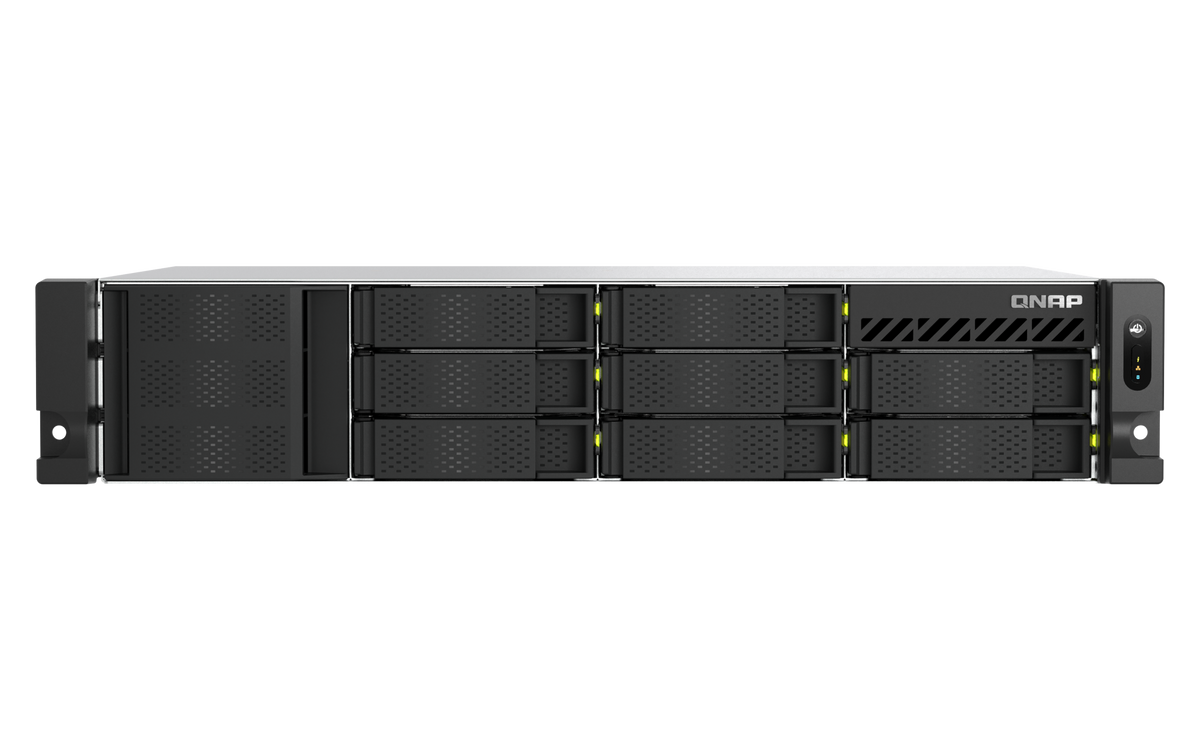
Keep Critical Storage Connected Through a Power-Module Fault Bring capacity, SSD acceleration and business data services together in the QNAP TS-h1073BXeU-RP. Its compact 2U chassis combines eight SATA bays with two E1.S/M.2 NVMe positions, leaving the main drive bays available for bulk storage. An AMD Ryzen Embedded quad-core processor, dual 10GbE copper ports and dual 2.5GbE ports support demanding shared-file and backup workflows. Redundant power supplies add protection against a power-module failure. Highlights A Purposeful Hybrid Layout Eight front SATA bays plus two rear E1.S/M.2 NVMe storage positions. Short-depth 2U chassis for suitable space-limited rack deployments. Processing and Networking AMD Ryzen Embedded V1780B 4-core/8-thread processor and 8GB DDR4 memory. Dual 10GBASE-T and dual 2.5GbE networking built in. Designed Around Continuity Two power modules provide power-supply redundancy. ZFS snapshots, Hybrid Backup Sync, shared-file permissions, containers and virtual machines. Key Features Put Capacity and Fast Storage in the Right Place Eight front SATA bays hold supported hard disks or SATA SSDs, while two rear E1.S/M.2 NVMe positions keep fast storage separate from the main capacity bays. Use compatible NVMe SSDs for an appropriate system pool, storage pool or cache design. Compatible M.2 NVMe SSDs use a QDA-E1SM2 adapter, while 9.5mm or 15mm E1.S SSDs require the matching tray. Select the installation parts for the exact drive. Suitable drive cooling and the exact compatibility list remain part of the installation. Networking for Shared Work and Backup Windows Two built-in 10GBASE-T ports and two 2.5GbE RJ45 ports give shared-file, backup and application workloads separate network options. Compatible PCIe Gen 3 x4 expansion supports further networking or storage choices within the card-size and interface limits. SMB Multichannel and supported port-trunking configurations can make better use of multiple links. Actual throughput depends on the complete network, client, storage and workload. ZFS Data Integrity with a Deliberate RAID Design QuTS hero uses ZFS checksums and copy-on-write storage, with self-healing when a suitable redundant copy is available. Supported RAID choices include RAID 1, 5, 6, 10, 50 and 60, together with triple mirror and triple parity where the drive layout permits. Select the operating system and RAID arrangement before initialisation; changing between QTS and QuTS hero requires an independent backup and reinitialisation. Snapshots, Retention and Storage Efficiency Shared-folder and LUN snapshots provide recovery points, while supported snapshot replication and SnapSync help protect data on another compatible system. QuTS hero adds inline compression and configurable WORM retention. Inline deduplication requires at least 16GB RAM, so it needs a memory upgrade from the supplied 8GB configuration. Match retention rules and resources to the value of the data. Backup Beyond the Original Enclosure Hybrid Backup Sync supports backup, restore and synchronisation to another NAS, external storage and supported cloud destinations, with RTRR and rsync for appropriate remote workflows. Qsync supports file synchronisation, and macOS Time Machine can use the NAS as a destination. Separate credentials, protected backup retention and tested restores help limit the impact of accidental deletion, ransomware or loss of the original system. A Central File Service for the Organisation SMB and NFS provide shared access for Windows, macOS and Linux systems, with File Station for browser management and iSCSI for suitable block-storage workloads. AD/LDAP integration, Windows ACLs and user/group permissions organise access. The published CIFS ceiling is 2,000 concurrent connections with maximum supported memory installed; practical sizing depends on active users, file sizes and other services. Virtual Machines and Containers with Resources in Reserve The AMD Ryzen Embedded V1780B provides four cores and eight threads, with 8GB DDR4 supplied and two SODIMM slots for supported matching modules. Virtualization Station runs supported x86 guest operating systems, while Container Station hosts compatible containers. Reserve CPU and memory for NAS services, ZFS and the applications actually in use. Guest operating systems and some applications have separate licensing requirements. Power and Rack Support Around the Deployment Two redundant power modules allow the NAS to continue through a single power-module failure when supplied with suitable power. Use independent protected feeds where possible and a correctly sized UPS for orderly shutdown through a mains outage. The short 2U chassis still requires the correct rail kit, mounting-post spacing and rear cable clearance. NASCare, compatible rails and suitable NAS drives are listed as optional add-ons. Surveillance with Clear Licence Boundaries QVR Surveillance includes two channels and a further six after NAS registration and activation, subject to the installed operating system and app. QVR Pro has a separate eight-channel entitlement on supported QTS installations. Each recording application has its own channel entitlement. QNAP directs model-specific channel sizing to its Surveillance NAS Selector; extra-channel availability depends on the chosen NAS, QVR version, licences and camera settings. Summary The TS-h1073BXeU-RP brings a flexible SATA and NVMe layout to a compact rackmount platform, with dual 10GbE networking already built in and redundant power supplies. It suits a business that wants shared files, structured backups and room for compatible application workloads. Choose the drives, rack support and backup design as one complete system. Frequently Asked Questions Are Hard Disks or SSDs Included?ExpandCollapse No. This is a diskless enclosure with the supplied memory. Choose exact drive models from QNAP’s compatibility list. Storage, optional network hardware and additional application licences are separate. Will It Fit My Rack?ExpandCollapse Check the chassis height and depth, mounting-post spacing, rack-hole type and rear connector clearance. Select the exact rail kit for the NAS and cabinet. Rails are a separate purchase; a shallow chassis alone does not establish compatibility. Is 10GbE Included?ExpandCollapse Yes. Two 10GBASE-T copper ports and two 2.5GbE ports are built in. Actual transfer speeds depend on storage, switches, clients and workload. Can I Add NVMe SSDs?ExpandCollapse Yes. Two rear E1.S/M.2 NVMe positions support appropriate compatible drives. M.2 drives require the correct adapter, while E1.S drives require the matching tray. Follow the exact drive-size, cooling and installation requirements. How Many Camera Channels Are Included?ExpandCollapse QVR Surveillance starts with two free channels. Register the NAS and activate six additional channels to use eight at no channel charge, subject to the supported operating system and application. Extra-channel availability depends on the NAS and QVR version; confirm compatibility and licensing before planning beyond the free entitlement. Resolution, bitrate, storage and concurrent applications affect the practical design. Does RAID or Redundant Power Replace a Backup?ExpandCollapse No. RAID addresses certain drive failures, and redundant power addresses a power-module failure where fitted. Neither provides a separate copy against deletion, ransomware, fire or loss of the NAS. Keep a current independent backup and test restoration.
추가 상품 (3)
3005, Ubi Avenue 3, #01-88에서 픽업 가능
일반적으로 2~4일 후 준비 완료
QNAP TS-h1073BXeU-RP 10-Bay Redundant Power Dual 10GbE Short-Depth Rackmount NAS
제품 설명
Keep Critical Storage Connected Through a Power-Module Fault
Bring capacity, SSD acceleration and business data services together in the QNAP TS-h1073BXeU-RP. Its compact 2U chassis combines eight SATA bays with two E1.S/M.2 NVMe positions, leaving the main drive bays available for bulk storage. An AMD Ryzen Embedded quad-core processor, dual 10GbE copper ports and dual 2.5GbE ports support demanding shared-file and backup workflows. Redundant power supplies add protection against a power-module failure.
Highlights
A Purposeful Hybrid Layout
- Eight front SATA bays plus two rear E1.S/M.2 NVMe storage positions.
- Short-depth 2U chassis for suitable space-limited rack deployments.
Processing and Networking
- AMD Ryzen Embedded V1780B 4-core/8-thread processor and 8GB DDR4 memory.
- Dual 10GBASE-T and dual 2.5GbE networking built in.
Designed Around Continuity
- Two power modules provide power-supply redundancy.
- ZFS snapshots, Hybrid Backup Sync, shared-file permissions, containers and virtual machines.
Key Features
Put Capacity and Fast Storage in the Right Place
Eight front SATA bays hold supported hard disks or SATA SSDs, while two rear E1.S/M.2 NVMe positions keep fast storage separate from the main capacity bays. Use compatible NVMe SSDs for an appropriate system pool, storage pool or cache design. Compatible M.2 NVMe SSDs use a QDA-E1SM2 adapter, while 9.5mm or 15mm E1.S SSDs require the matching tray. Select the installation parts for the exact drive. Suitable drive cooling and the exact compatibility list remain part of the installation.
Networking for Shared Work and Backup Windows
Two built-in 10GBASE-T ports and two 2.5GbE RJ45 ports give shared-file, backup and application workloads separate network options. Compatible PCIe Gen 3 x4 expansion supports further networking or storage choices within the card-size and interface limits. SMB Multichannel and supported port-trunking configurations can make better use of multiple links. Actual throughput depends on the complete network, client, storage and workload.
ZFS Data Integrity with a Deliberate RAID Design
QuTS hero uses ZFS checksums and copy-on-write storage, with self-healing when a suitable redundant copy is available. Supported RAID choices include RAID 1, 5, 6, 10, 50 and 60, together with triple mirror and triple parity where the drive layout permits. Select the operating system and RAID arrangement before initialisation; changing between QTS and QuTS hero requires an independent backup and reinitialisation.
Snapshots, Retention and Storage Efficiency
Shared-folder and LUN snapshots provide recovery points, while supported snapshot replication and SnapSync help protect data on another compatible system. QuTS hero adds inline compression and configurable WORM retention. Inline deduplication requires at least 16GB RAM, so it needs a memory upgrade from the supplied 8GB configuration. Match retention rules and resources to the value of the data.
Backup Beyond the Original Enclosure
Hybrid Backup Sync supports backup, restore and synchronisation to another NAS, external storage and supported cloud destinations, with RTRR and rsync for appropriate remote workflows. Qsync supports file synchronisation, and macOS Time Machine can use the NAS as a destination. Separate credentials, protected backup retention and tested restores help limit the impact of accidental deletion, ransomware or loss of the original system.
A Central File Service for the Organisation
SMB and NFS provide shared access for Windows, macOS and Linux systems, with File Station for browser management and iSCSI for suitable block-storage workloads. AD/LDAP integration, Windows ACLs and user/group permissions organise access. The published CIFS ceiling is 2,000 concurrent connections with maximum supported memory installed; practical sizing depends on active users, file sizes and other services.
Virtual Machines and Containers with Resources in Reserve
The AMD Ryzen Embedded V1780B provides four cores and eight threads, with 8GB DDR4 supplied and two SODIMM slots for supported matching modules. Virtualization Station runs supported x86 guest operating systems, while Container Station hosts compatible containers. Reserve CPU and memory for NAS services, ZFS and the applications actually in use. Guest operating systems and some applications have separate licensing requirements.
Power and Rack Support Around the Deployment
Two redundant power modules allow the NAS to continue through a single power-module failure when supplied with suitable power. Use independent protected feeds where possible and a correctly sized UPS for orderly shutdown through a mains outage. The short 2U chassis still requires the correct rail kit, mounting-post spacing and rear cable clearance. NASCare, compatible rails and suitable NAS drives are listed as optional add-ons.
Surveillance with Clear Licence Boundaries
QVR Surveillance includes two channels and a further six after NAS registration and activation, subject to the installed operating system and app. QVR Pro has a separate eight-channel entitlement on supported QTS installations. Each recording application has its own channel entitlement. QNAP directs model-specific channel sizing to its Surveillance NAS Selector; extra-channel availability depends on the chosen NAS, QVR version, licences and camera settings.
Summary
The TS-h1073BXeU-RP brings a flexible SATA and NVMe layout to a compact rackmount platform, with dual 10GbE networking already built in and redundant power supplies. It suits a business that wants shared files, structured backups and room for compatible application workloads. Choose the drives, rack support and backup design as one complete system.
Frequently Asked Questions
Are Hard Disks or SSDs Included?
No. This is a diskless enclosure with the supplied memory. Choose exact drive models from QNAP’s compatibility list. Storage, optional network hardware and additional application licences are separate.
Will It Fit My Rack?
Check the chassis height and depth, mounting-post spacing, rack-hole type and rear connector clearance. Select the exact rail kit for the NAS and cabinet. Rails are a separate purchase; a shallow chassis alone does not establish compatibility.
Is 10GbE Included?
Yes. Two 10GBASE-T copper ports and two 2.5GbE ports are built in. Actual transfer speeds depend on storage, switches, clients and workload.
Can I Add NVMe SSDs?
Yes. Two rear E1.S/M.2 NVMe positions support appropriate compatible drives. M.2 drives require the correct adapter, while E1.S drives require the matching tray. Follow the exact drive-size, cooling and installation requirements.
How Many Camera Channels Are Included?
QVR Surveillance starts with two free channels. Register the NAS and activate six additional channels to use eight at no channel charge, subject to the supported operating system and application. Extra-channel availability depends on the NAS and QVR version; confirm compatibility and licensing before planning beyond the free entitlement. Resolution, bitrate, storage and concurrent applications affect the practical design.
Does RAID or Redundant Power Replace a Backup?
No. RAID addresses certain drive failures, and redundant power addresses a power-module failure where fitted. Neither provides a separate copy against deletion, ransomware, fire or loss of the NAS. Keep a current independent backup and test restoration.
사양
QNAP TS-h1073BXeU-RP 10-Bay Redundant Power Dual 10GbE Short-Depth Rackmount NAS
Specifications apply to the diskless enclosure with the supplied memory. Software limits depend on the installed operating system and supported app version; RAID choices depend on drive count. Storage, rails and optional expansion are separate.
| Specification | Details |
|---|---|
| Processor and Memory | |
| Processor | AMD Ryzen Embedded V1780B, 4 cores / 8 threads |
| Supplied Memory | 8GB DDR4 SODIMM |
| Memory Expansion | 2 DDR4 SODIMM slots; use matching supported modules |
| Encryption Acceleration | AES-NI hardware encryption engine |
| Drive Bays and SSD Storage | |
| SATA Bays | 8 front SATA 6Gbps bays |
| Supported Main-Bay Drives | Compatible 3.5-inch SATA HDDs and 2.5-inch SATA SSDs; diskless enclosure |
| Rear NVMe Storage | 2 rear E1.S/M.2 NVMe positions |
| NVMe Installation | M.2 uses compatible QDA-E1SM2 adapter; 9.5/15mm E1.S drives use matching tray |
| SSD Acceleration | SSD storage pools and supported cache; arrangement depends on OS and drive layout |
| Networking | |
| Built-in Ethernet | 2 × 10GBASE-T RJ45; 2 × 2.5GbE RJ45 |
| Network Features | SMB Multichannel, port trunking and VLAN; supported network configuration required |
| 10GbE Connection | Built-in copper 10GbE; suitable cabling, switch and client required |
| USB and PCIe Expansion | |
| USB | USB 3.2 Gen 2 10Gbps: 1 × Type-C and 2 × Type-A |
| PCIe Slot | 1 × PCIe Gen 3 x4 |
| PCIe Card Size | 190 × 68.9 × 18.76mm |
| Operating System and RAID | |
| Operating System | QuTS hero; QTS also supported with reinitialisation |
| Internal File System | ZFS under QuTS hero; ext4 under QTS |
| RAID with QTS | Single, JBOD, RAID 0, 1, 5, 6, 10, 50, 60 |
| RAID with QuTS hero | Single, RAID 0, 1, 5, 6, 10, 50, 60; triple mirror and triple parity |
| RAID Requirements | Available layouts depend on drive count, OS and compatible storage configuration |
| Snapshots and Backup | |
| Snapshots | QuTS hero shared-folder / LUN snapshots; QTS volume / LUN snapshots |
| Snapshot Protection | Snapshot Replica / Snapshot Vault; independent backup remains required |
| NAS Backup and Sync | Hybrid Backup Sync; local, remote NAS and supported cloud destinations; RTRR / rsync |
| Client File Protection | Qsync synchronisation; macOS Time Machine backup destination |
| ZFS Integrity and Retention | Checksums, copy-on-write, supported self-healing and WORM retention |
| Data Reduction | Inline compression; inline deduplication requires at least 16GB RAM |
| File Services and Directory Integration | |
| File Services | SMB/CIFS, NFS, FTP/FTPS/SFTP and WebDAV; File Station browser management |
| Block Storage | iSCSI targets and block-based LUNs; supported snapshot and MPIO workflows |
| Directory Integration | Windows AD / LDAP; user and group permissions; Windows ACLs |
| Users and Connections | |
| Local User Accounts | Up to 16,000 under QuTS hero; 4,096 under QTS |
| Local Groups | Up to 512 |
| Concurrent CIFS Connections | Up to 2,000 with maximum supported memory; workload dependent |
| Security and Administration | |
| Access Security | Two-step verification, allow/deny rules and network access protection |
| Data and Connections | Supported AES-256 encryption; HTTPS and SSH; security settings depend on OS |
| System Administration | Resource Monitor, system logs and Notification Center |
| Applications and Virtualisation | |
| Container Station | Compatible containers; allocate CPU and RAM alongside NAS services |
| Virtual Machines | Virtualization Station for supported x86 guest operating systems; minimum 4GB app requirement |
| Application Requirements | App, OS, memory and licence requirements apply; guest OS licences separate |
| Surveillance | |
| QVR Surveillance Free Channels | 2 included + 6 after NAS registration and activation = 8; supported OS / app required |
| QVR Pro Free Channels | 8 on supported QTS installations; separate from the QVR Surveillance entitlement |
| Maximum Camera Configuration | Model-specific sizing via QNAP Surveillance NAS Selector; depends on QVR version, camera bitrate and NAS workload |
| Expansion and Licensing | Confirm extra-channel availability and compatible licences for the selected NAS / app |
| Rackmount and Dimensions | |
| Form Factor | 2U short-depth rackmount |
| Dimensions H × W × D | 88.6 × 432 × 294.9mm |
| Rack Mounting | Compatible rail kit supplied separately; verify cabinet post spacing and rear clearance |
| Power, Environment and Warranty | |
| Power Supply | 2 × 350W redundant, 100–240V AC |
| Cooling | 4 × 50mm fans |
| Operating Environment | 0–40°C; 5–95% RH non-condensing |
| Storage Temperature | −20–70°C |
| Warranty | 3 years |
추가 상품


NASCare Extended Warranty with Loaner Unit for 9-12 Bays


QNAP Rail Kit C01/B01/B02/A02-90/A03-57/E02/E03/S01/S02

