
Audio
Better Bookshelf Speaker Sound: Placement, Bass and a Proper Stereo Image
A music corner should reward you every time you sit down. Start with speaker position and the listening seat before adding more bass or buying another box.
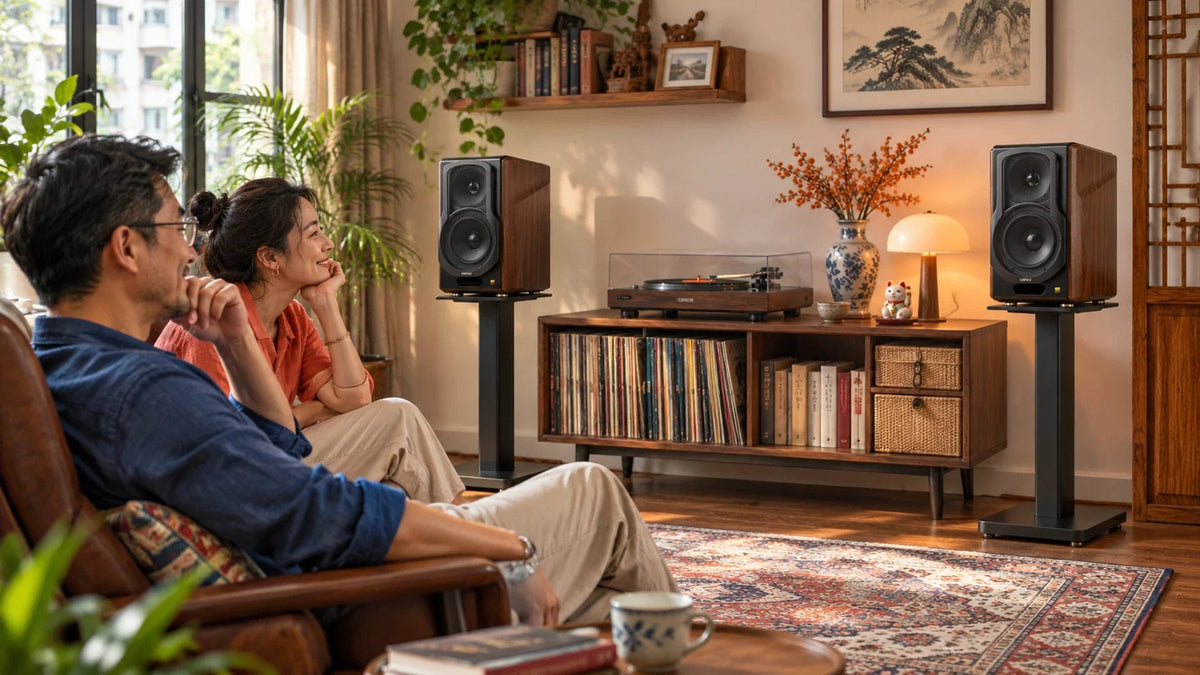
For clearer stereo sound, place the two speakers at the same height, aim them towards your listening seat and start with roughly equal distances between all three positions. Then adjust the seat, wall distance and bass setting one change at a time. More amplifier power will not correct a speaker hidden behind a monitor or a seat in a deep bass cancellation.
You finally have an evening to play a favourite album. The speakers look lovely, but the singer seems to come from one side and the bass overwhelms the room. Before deciding that the system is disappointing, give its position the same attention as its specification.
A satisfying setup can still fit a normal living room or work desk. The aim is a believable centre vocal, useful detail at comfortable volume and a listening position you actually enjoy using.
Build a Listening Triangle Before Adjusting Bass
Begin with the left speaker, right speaker and your head forming an approximate equilateral triangle. Keep the cabinets upright and aim them towards the listening position. This is a starting arrangement, not a rule that overrides a particular speaker’s instructions or the room.
Make the Listening Position Part of the System
A simple starting geometry, followed by a real listening check.
01 The stereo starting point
Top view: two speakers + listenerBegin with similar distances and a clear path to both ears. The symbols show positions, not cabinet scale.
02 Then check the room
Listen from the real seatWall effects, furniture and the listening position remain part of the result.
Use a familiar recording with a centred vocal. From the middle seat, the singer should appear between the speakers rather than stick to one cabinet. Check channel balance, speaker distances and obstacles if the image leans to one side. A curtain on one side and a bare wall immediately beside the other can create an uneven result even with matching cabinets.
On a desk, placing both speakers beside each other under the screen largely throws away the advantage of a stereo pair. Move them apart within the available space, without putting one on a bookcase across the room and expecting a stable central image.
Get the Speaker Height and Supports Right
Bring the high-frequency section close to seated ear height, using a suitable stand or a secure tilt where appropriate. Keep the direct path to both ears clear. A screen, stack of books or tall desk accessory between the speaker and listener can change what you hear.

Choose supports that accommodate the entire base and weight, with stable contact and a safe route for the cables. A small stand under only part of a heavy cabinet is not an upgrade. Isolation pads may help with vibration transmitted into furniture; they cannot remove every reflection or room resonance.
Keep the left and right arrangements similar. One cabinet on a rigid stand and the other inside a resonant cupboard introduce different surroundings before the music even starts.
Fix Boomy Bass Without Making Music Thin
Walls, corners and the listening position affect low frequencies. If one bass note dominates, try a small change in cabinet or seat position before raising or lowering every bass note with an equaliser. Keep rear vents and connectors clear according to the product manual.
| What You Hear | What to Try First |
|---|---|
| Bass dominates near a corner | Compare a position farther from the corner and check the speaker’s bass setting. |
| Bass disappears at one seat | Move the listening position forwards or backwards and compare; adding a large boost may not fill a cancellation. |
| Vocal pulls to one side | Check balance, equal distance, obstructions and different nearby surfaces. |
| Sound changes when you lean forward | Review listening distance, height and reflections from the desk. |
There is no universal wall gap that works for every room and cabinet. Move in manageable steps, replay the same short passage and keep the change that improves the whole presentation. An impressive thump on one track is less useful than balanced sound across the music you enjoy.
Choose Connections for the Room
The Edifier S2000MKIII is an active bookshelf pair with built-in amplification, two analogue line inputs, optical, coaxial and Bluetooth. It suits a dedicated music corner without a separate power amplifier. The cabinets still need their supplied interconnecting lead and the required mains connection.

Check the cabinet size, connection types and support space as carefully as the amplifier rating.
Match the source to an actual input. USB audio and HDMI ARC are not listed inputs on this model. A turntable with a phono-only output needs a suitable phono preamplifier before a line input; a turntable already providing a line output follows a different connection path.
Bluetooth can be convenient, but a supported codec requires support at both ends. Do not assume that every phone supplies aptX HD. If the problem is electrical noise rather than placement, use the speaker buzz and hum guide to isolate the source path.
A 15-Minute Listening Check You Can Repeat
- Return to a simple baseline. Use a familiar source, moderate volume and a known listening preset. Avoid several overlapping bass boosts.
- Check the centre. Sit midway between the speakers and play a familiar vocal. Confirm left and right channels are connected correctly.
- Check the height. Compare your normal position with a small change in seated height, without moving the speakers unsafely.
- Compare one position change. Adjust the seat or cabinets, then replay the same passage at the same level.
- Listen beyond bass. Check speech, cymbals and quieter details on more than one recording before keeping the change.
This is a practical listening routine, not a laboratory measurement or a promised improvement. A quick note or photograph of the positions makes it easier to return to the better arrangement after cleaning or rearranging the room.
When New Hardware Is the Sensible Upgrade
Upgrade when the existing system cannot provide the connections, comfortable listening level or physical arrangement you need. A compact desk may benefit more from smaller cabinets on suitable supports than a larger pair squeezed behind the screen. A bigger room may need a different system rather than extreme equaliser settings.
For the S2000MKIII, compare its Monitor, Dynamic, Classic and Vocal presets after establishing a sensible position. Pick by the material you play and the sound you prefer, rather than treating one label as a universal accuracy setting.
Build the listening space before chasing another specification. Two clear paths to the listener, stable supports and a balanced room arrangement make the stereo pair useful. Choose new equipment when a defined connection, size or listening requirement remains unsatisfied.
Frequently Asked Questions
How far apart should bookshelf speakers be?
Start with roughly equal distances between the two speakers and the listening position, then adjust for the room and the manufacturer’s guidance. There is no single separation that suits every desk and room.
Can bookshelf speakers go inside a bookcase?
Only where the model’s clearance, ventilation and support requirements can be met. An enclosed shelf changes the acoustic surroundings and can obstruct the sound or rear connections.
Will isolation pads remove boomy bass?
They can help with vibration passed into furniture. Room resonances, boundary effects and seat-position cancellations need separate attention.
Should the left and right speakers face straight ahead?
Start with both aimed towards the listening seat, then compare small changes according to the model’s guidance. Keep the two arrangements consistent.
Does the S2000MKIII need an external amplifier?
No. Amplification is built into the active system. Use a suitable source connection, the supplied inter-speaker lead and the required mains power.
Should I buy a subwoofer before moving the speakers?
First check placement, the seat and the existing bass controls. A subwoofer addresses a defined low-frequency requirement; it does not automatically fix an uneven room or blocked stereo image.


